
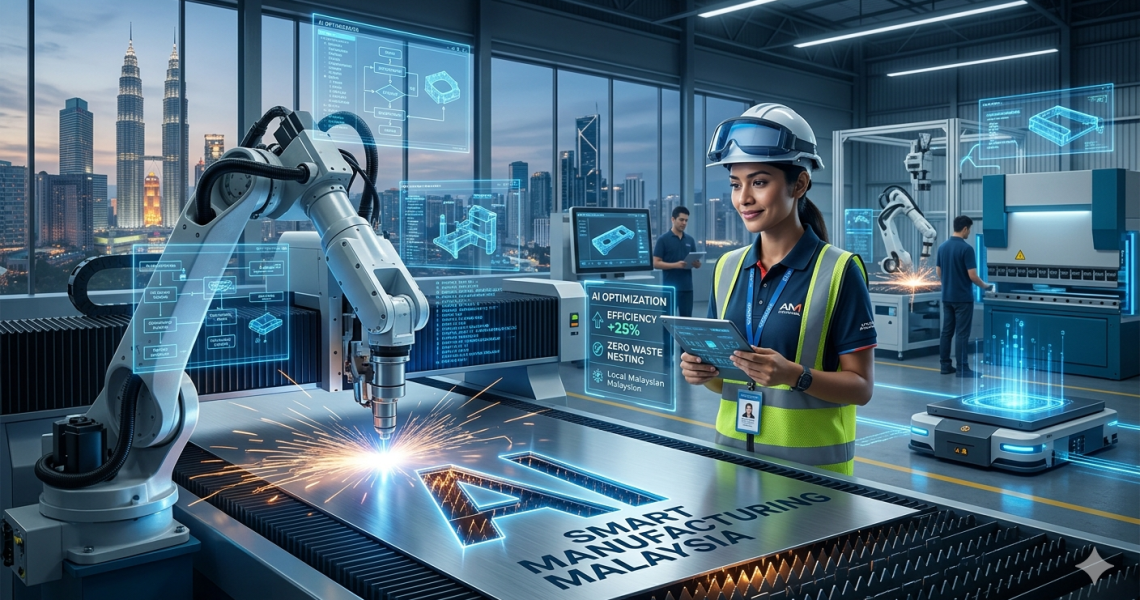
1. Executive Summary: The Industrial Awakening
Malaysia’s manufacturing sector has long stood as a foundational pillar of Southeast Asia’s industrial economy. Historically celebrated as a high-volume assembly hub, the landscape is undergoing a profound structural evolution. At the center of this paradigm shift is the precision sheet metal and fabrication industry—a sector traditionally viewed as a mechanical, labor-intensive trade. Driven by aggressive regional competition, evolving national master plans, and an unprecedented domestic tech boom, Malaysian metal fabricators are rapidly digitizing.
Artificial Intelligence (AI) is no longer a futuristic concept confined to software suites in Silicon Valley; it is actively modifying shop floors from Penang to the Klang Valley and Johor. By integrating computer vision, predictive machine learning algorithms, and automated data processing, Malaysia’s precision engineering ecosystems are shifting toward true Industry 4.0 paradigms. This comprehensive analysis explores how AI-driven systems are reshaping traditional workflows, optimizing local supply chains, and elevating Malaysian fabricators to global prominence.
- Up to 85% Reduction in CAD-to-Quote Turnaround Times
- 15% to 25% Reduction in Raw Material Scrap and Waste
- 30% Average Increase in Cutting Machine Uptime and Efficiency
Reference:https://www.linkedin.com/pulse/future-sheet-metal-drafting-ai-automation-dr-nimesh-soni-phd-me-qmo1f
2. The Macro Catalyst: Semis, Data Centers, and NIMP 2030
To understand why AI adoption is accelerating so quickly in Malaysia’s sheet metal shops, one must look at the broader macroeconomic picture. The global supply chain realignments of the mid-2020s have funneled billions of dollars in foreign direct investment (FDI) into Malaysia. Two primary sectors are driving this expansion: semiconductors and hyperscale data centers.
The Silicon Hub & Data Center Explosion
Malaysia, particularly Penang and Kulim, accounts for roughly 13% of global semiconductor packaging, assembly, and testing services. Simultaneously, regions like Johor and Selangor have emerged as the fastest-growing data center hubs in the Asia-Pacific region. These two high-tech industries share an insatiable demand for ultra-precise structural hardware. A data center requires thousands of customized server racks, specialized cooling enclosures, complex busbars, and robust structural framing. A semiconductor testing facility requires cleanroom-grade, micro-tolerance machine chassis, shielding panels, and custom-machined enclosures.
Traditional sheet metal fabrication methods struggle to keep pace with these requirements. The micro-tolerances demanded by multinational chipmakers leave zero margin for human error. To capture these lucrative contracts, local fabricators must deliver impeccable quality at lightning speeds. AI has emerged as the structural bridge enabling local manufacturers to scale up and meet these rigid, global standards.
Government Tailwinds: NIMP 2030
This technological upgrade directly aligns with the Malaysian government’s policy goals. The New Industrial Master Plan 2030 (NIMP 2030) explicitly highlights advanced manufacturing technologies, automation, and AI integration as core objectives to elevate the country’s industrial value chain. Through targeted tax incentives, automated capital allowances, and digitization grants administered by agencies like the Malaysian Investment Development Authority (MIDA) and MDEC, the government has reduced the capital barriers preventing small and medium enterprises (SMEs) from acquiring advanced tech infrastructure.
3. Revolutionizing the Front Office: AI-Powered Smart Quoting
The transformation of a modern sheet metal plant does not begin at the laser cutter; it begins in the estimating office. Historically, the Request for Quote (RFQ) process was a significant operational bottleneck for Malaysian fabricators.
In standard job shops, an engineer could spend hours or days analyzing a single 3D CAD file, manually calculating bend allowances, material utilization, and labor costs. If a quote takes three days to prepare, the contract is often already lost to a faster competitor.
Eliminating the Guesswork with Geometric Machine Learning
AI-driven estimating platforms are completely changing this workflow. When a client uploads a 3D CAD file (such as a STEP or IGES format) into an AI-integrated Manufacturing Execution System (MES), geometric machine learning algorithms instantly analyze the digital asset. The AI reads the entire geometry of the part, determining:
- The exact unfolding dimensions and flat-pattern layout of the metal sheet.
- The precise number of bends, punches, and cuts required.
- Potential manufacturing defects, such as folds placed too close to a hole, which could cause material tearing.
By cross-referencing this structural data with real-time localized material prices, current shop-floor machine availability, and labor indices, the AI generates a highly accurate, production-ready quote in under a minute. This capability allows Malaysian fabricators to transition from slow, reactive pricing models to instant, proactive bidding, significantly increasing quote-to-order conversion rates.
4. Optimizing Material Yields: AI-Driven Intelligent Nesting
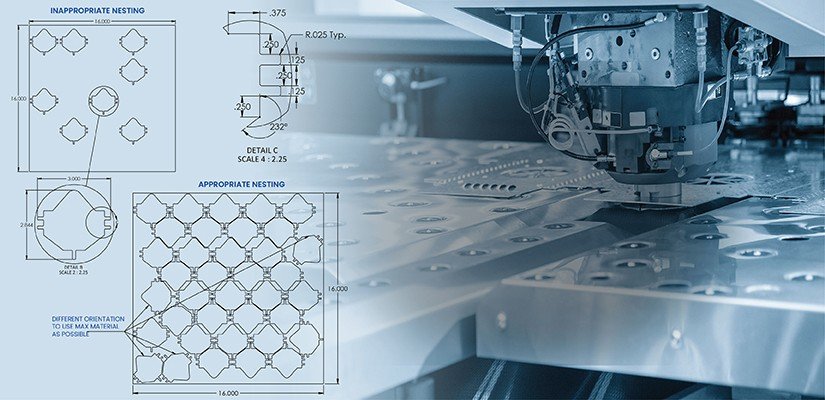
Raw material costs represent one of the largest ongoing expenses in sheet metal fabrication, frequently accounting for up to 50% to 70% of total production costs. Historically, maximizing the layout of various parts onto a standard metal sheet—a process known as “nesting”—depended on the expertise of a CAD/CAM programmer using deterministic software.
Dynamic Genetic Algorithms vs. Legacy Systems
| Operational Metric | Traditional Methods | AI-Enhanced Systems |
| Nesting Efficiency | 70% – 80% material utilization | 88% – 96% material utilization |
| Programming Time | 30 to 60 minutes per layout | Under 2 minutes via automated cloud compute |
| Scrap Sheet Management | Manual tracking, high inventory drag | Dynamic computer vision re-entry into inventory |
| Setup & Tooling Delays | High reliance on manual trial-and-error | Predictive algorithm optimization based on tool life |
Standard legacy nesting software arranges parts sequentially or based on simple geometric bounding boxes. In contrast, AI-driven nesting software leverages advanced genetic algorithms and machine learning to evaluate millions of potential spatial layouts within seconds. It considers not just the raw shape of the pieces, but also the grain direction of the metal, thermal distortion vectors from the laser, and the optimal cutting path to minimize machine head movement.
Furthermore, if an order changes mid-production, the AI can dynamically re-nest the remainder of the sheet in real time, slotting in smaller parts from entirely different customer orders to fill blank spaces. This fluid agility reduces scrap rates to historic lows, directly improving profitability while simultaneously supporting corporate sustainability goals.
5. The Intelligent Shop Floor: Autonomous Cutting and Bending
On the physical factory floor, the integration of AI with advanced CNC (Computer Numerical Control) laser cutters and press brakes is redefining production speed and consistency.
Smart Laser Cutting and Thermal Compensation
High-powered fiber lasers (ranging from 10kW to over 30kW) cut through thick steel plates at blistering speeds. However, intense local heat can introduce thermal stress, warping the raw material and altering the final part dimensions. Modern AI-equipped laser systems utilize real-time sensor arrays and embedded computer vision cameras inside the cutting cabin.
As the laser head moves, the AI monitors the micro-topography of the sheet, automatically adjusting cutting speed, gas pressure, and focal length on the fly to compensate for shifting material temperatures or subtle defects in the steel alloy. If a piece tips up after being cut—a common hazard that can crash a multimillion-ringgit machine—the computer vision system flags it in milliseconds, halting operations before any physical damage or costly downtime occurs.
AI-Guided Precision Bending
Sheet metal bending is a complex art. Factors like “springback” (the tendency of a metal sheet to partially return to its original flat shape after being bent by a press brake) vary based on the specific batch of material, its hardness, and even structural grain direction. Traditionally, machine operators performed manual test bends, adjusting the machine’s stroke depth through slow trial and error.
AI-enabled press brakes feature integrated angle measurement sensors linked to deep learning models. During the very first press stroke, the system measures the material’s resistance and structural deflection, calculates the exact springback coefficient for that specific sheet of metal, and automatically adjusts the punch depth mid-stroke. The result is a perfect bend angle on the first attempt, eliminating manual setup waste and ensuring strict compliance with tight mechanical tolerances.
6. Predictive Maintenance: Eliminating Costly Factory Downtime
In a capital-intensive industry like precision metal fabrication, unplanned machine downtime can devastate a business’s reputation and financial performance. If a high-volume fiber laser or an automated punch press breaks down unexpectedly, entire assembly lines at downstream client facilities—such as semiconductor packaging lines—can grind to an expensive halt.
Malaysian fabricators are leveraging Internet of Things (IoT) sensor networks and machine learning to pivot from reactive maintenance models to proactive predictive strategies. CNC machines are outfitted with specialized sensors that continuously capture high-frequency telemetry data, including:
- Acoustic emissions and vibration frequencies from cutting heads and drive motors.
- Temperature fluctuations in hydraulic systems and electrical cabinets.
- Power consumption spikes and gas pressure consistency.
AI algorithms analyze this continuous data stream to establish a normal operational baseline. By identifying subtle anomalies—such as an unusual micro-vibration pattern in a bearing or a minor efficiency drop in a cooling pump—the AI can accurately predict a component failure weeks before it occurs. Maintenance teams can then schedule repairs during planned shift changes, preventing catastrophic equipment failure, preserving expensive component lifespan, and ensuring completely stable delivery timelines.
7. Quality Assurance via Edge Computer Vision
Quality control in conventional manufacturing has traditionally relied on manual post-production inspections. Inspectors use calipers, micrometers, and gauges to check a small percentage of finished parts. This sample-based approach is inherently flawed: it allows defective parts to slip through undetected and catches errors only after an entire production run has already been completed.
AI-powered edge computer vision systems are completely transforming this phase of production. High-resolution cameras installed directly above the laser unloading beds or integrated into robotic sorting arms capture images of every single processed part. Industrial-grade neural networks instantly compare these images against the original 3D CAD master file.
The AI system can identify micro-cracks along bend lines, burrs along laser-cut edges, and dimensional deviations measured in microns—all in real time. If a recurring defect is detected (for example, a consistent burr appearing on a specific corner), the AI instantly traces the issue back to the source machine, automatically notifying the shop floor manager that a nozzle change or tool calibration is required. This real-time feedback loop shifts quality assurance from a retrospective review to an active, preventative process.
8. Overcoming Challenges: The Road Map for Malaysian Fabricators
While the operational advantages of Artificial Intelligence are clear, the path to complete digital transformation across Malaysia’s industrial sector presents several real-world challenges that must be addressed.
The Skills Gap and Workforce Upskilling
The most pressing hurdle is not a lack of financial capital, but rather a shortage of specialized talent. Operating an AI-enhanced manufacturing facility requires a completely different skill set than managing a traditional manual job shop. Malaysia requires an engineering workforce that bridges the gap between mechanical engineering, robotic programming, and data science.
Existing plant technicians must be systematically upskilled to interact with automated dashboards, interpret predictive maintenance reports, and manage algorithmic workflows. Collaborations between local industry consortiums, technical universities, and government bodies like HRD Corp are vital to creating new specialized training modules focused on advanced manufacturing analytics.
Data Silos and Legacy Equipment Integration
Many established sheet metal firms in Malaysia operate with a mix of modern machinery and older, legacy equipment that lacks native digital connectivity. Creating a unified, facility-wide AI ecosystem requires breaking down these data silos. Fabricators must invest in retrofitting older machines with external IoT sensors and deploying robust middleware solutions capable of translating various legacy industrial protocols into clean, structured data pools that can feed centralized AI models.
9. Conclusion: The New Era of Malaysian Manufacturing
The integration of Artificial Intelligence into Malaysia’s sheet metal and precision metal industry represents a structural turning point. Driven by the demands of booming regional tech sectors like semiconductors and data centers, local fabricators are successfully shedding the outdated image of low-margin, manual operations. By embracing AI-powered estimators, adaptive nesting algorithms, real-time computer vision quality control, and predictive maintenance networks, Malaysia’s manufacturing ecosystem is actively building a highly sophisticated, future-proof framework.
As the regional landscape continues to evolve under the guidance of national frameworks like NIMP 2030, the companies that invest early in digital infrastructure will secure their positions as indispensable partners in the global technology supply chain. For Malaysian sheet metal fabricators, the message is clear: the future of precision manufacturing is digital, autonomous, and powered by AI.
Visit us at www.luxmetalgroup.com to explore our services or request a quote.
📚 References
For more information on these developments, explore the following authoritative sources:
How AI is Streamlining Workflow in Metal Fabrication