
When a part looks simple on paper but fails at fit-up, the problem is often in the forming. Metal rolling and forming services are not just about changing shape. They determine whether a component holds tolerance, matches downstream assemblies, and performs consistently from prototype through production.
For OEMs, contractors, and industrial buyers, that matters because forming errors rarely stay isolated. A rolled panel that springs back too far can affect welding. A bent profile with poor consistency can slow assembly. A formed enclosure that drifts out of tolerance can create installation issues on site. The right fabrication partner treats rolling and forming as controlled engineering processes, not just machine operations.
What metal rolling and forming services actually cover
The term includes a range of processes used to reshape metal stock into finished or near-finished components. In practical manufacturing terms, this usually means taking flat sheet, plate, tube, or structural sections and producing a required radius, angle, profile, or contour without compromising material integrity.
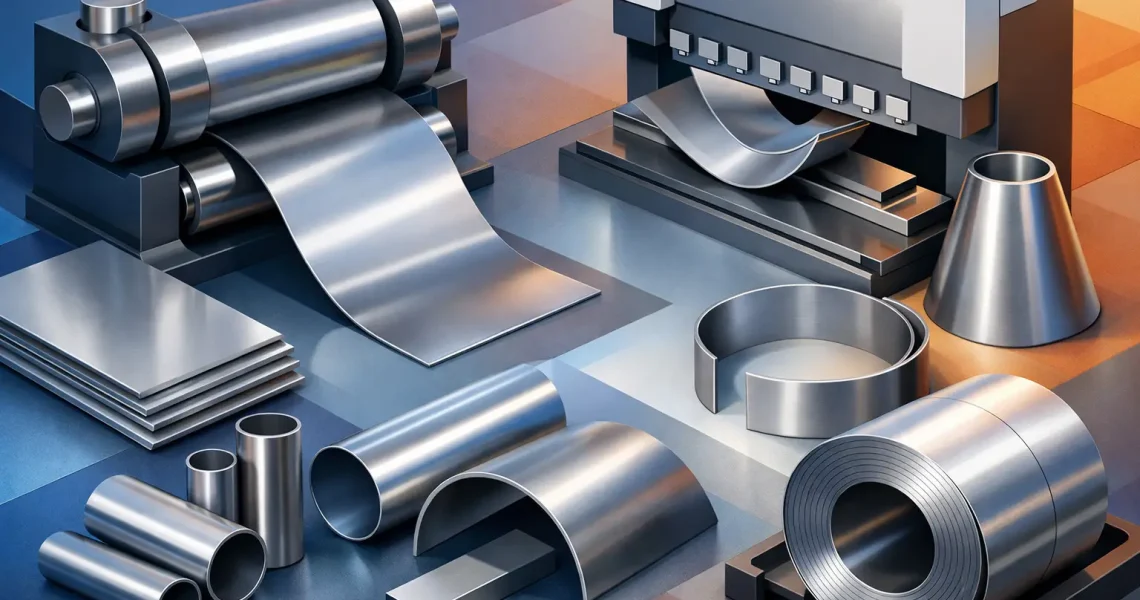
Rolling is commonly used to create cylindrical sections, curved panels, cones, rings, and large-radius parts. Forming can include press brake bending, tube bending, and shaped features that prepare a part for welding or final assembly. The exact process depends on the material, thickness, geometry, tolerance requirement, and end-use environment.
For industrial applications, these services are rarely standalone. They sit inside a larger workflow that may also include laser cutting, CNC punching, machining, welding, assembly, and inspection. That is where supplier capability starts to matter. If a forming vendor can only roll a part but cannot manage the cut accuracy, weld prep, or assembly integration, the buyer ends up coordinating multiple handoffs and carrying more production risk.
Why metal rolling and forming services matter in production
A formed part is only successful if it works in context. Engineers may specify radius, wall condition, flatness at interfaces, or hole position after forming because the part has to mate with other components. Procurement teams may focus on price, but operations teams usually feel the impact of poor forming quality first.
The most common issue is variation. Material springback changes with alloy, temper, thickness, and grain direction. Tight radii can mark the surface or distort nearby features. Tube bending can affect wall thickness and roundness. Plate rolling can leave flats at the ends if the process is not set correctly. None of these are unusual problems, but they need to be anticipated early.
This is why capability should be evaluated beyond basic equipment lists. A supplier with in-house machinery, experienced operators, and the ability to adjust forming strategy based on part function is far better positioned to deliver repeatable results than a shop that simply accepts a print and runs it.
Choosing the right process for the part
Not every curved or bent component should be made the same way. The right process depends on geometry and downstream requirements.
Sheet and plate rolling
Sheet and plate rolling are suited for large-radius parts, cylindrical shells, ducting sections, covers, tanks, guards, and structural curved panels. The advantage is smooth, continuous curvature over longer lengths. This process is often the best choice when a part needs visual consistency and accurate mating edges for welding or fastening.
The trade-off is that material thickness, width, and final radius all affect machine setup and achievable tolerance. Very tight radii or short flange transitions may require secondary operations or a different forming method.
Press brake forming
Press brake forming is commonly used when parts need defined angles, multiple bends, or precise flange relationships. It is often more suitable than rolling for brackets, enclosures, channels, supports, and precision sheet metal components with controlled bend locations.
This method offers strong repeatability, but it can become more complex when the part has many bend stages or when hole locations sit close to bend lines. Tooling selection and bend sequence matter a great deal.
Tube and profile bending
Tube bending is essential for frames, guards, piping supports, equipment structures, and fabricated assemblies. The main considerations are centerline radius, wall thickness, bend orientation, and distortion control. In many industrial applications, consistency from piece to piece is more important than hitting an aggressive bend speed.
For assemblies that require welding or fixture-based installation, even small variation in tube geometry can create costly rework. That is why tube bending should be treated as a controlled production process, not just a forming step.
What to look for in a metal rolling and forming partner
Industrial buyers usually need more than a machine capable of making a curve. They need a supplier that can manage tolerance, scale, and project complexity.
A good starting point is material range. Different metals respond differently in forming. Mild steel, stainless steel, aluminum, and specialty alloys each bring their own constraints around springback, surface marking, cracking risk, and achievable geometry. A capable partner should understand those differences and account for them in process planning.
The next factor is production integration. If your project also needs laser cutting, machining, welding, and final assembly, keeping those operations under one roof simplifies quality control and shortens lead times. It also reduces the chance that a part will pass one supplier’s check but fail at the next stage.
Inspection capability is another practical differentiator. For high-tolerance parts, visual acceptance is not enough. Buyers should expect dimensional verification against print requirements, especially where formed components interface with machined parts, fixtures, or installed systems.
Capacity matters too, but not just in terms of machine size. The real question is whether the supplier can support the life cycle of the project. Prototype responsiveness is useful. Production stability is critical. The best partners can do both without forcing a change in process quality as volumes increase.
Common applications across industrial sectors
Metal rolling and forming services support a wide range of sectors because curved and bent metal parts are fundamental to both equipment and infrastructure.
In automation and industrial machinery, formed parts appear in machine frames, housings, safety guards, cable management, and custom support structures. In electrical and control systems, they are used for cabinets, brackets, and enclosure components that require precise fit and clean assembly.
In semiconductor and pharmaceutical environments, the requirement usually shifts toward tighter tolerances, cleaner finishes, and better control of stainless steel fabrication quality. Aerospace and high-spec engineering work may add stricter demands for repeatability, documentation, and material traceability. Construction and commercial projects often involve larger formed sections where installation fit and structural consistency matter more than cosmetic perfection.
The process stays similar, but the acceptance criteria change by industry. That is why experience in the end-use sector can be just as valuable as forming capability itself.
Why turnkey execution reduces risk
Many formed parts become difficult only after the first operation. A rolled shell may need edge preparation, welded seams, machined interfaces, mounting holes, and final assembly checks. If those steps are split across multiple vendors, each handoff creates another opportunity for dimensional drift, scheduling delays, or responsibility disputes.
A turnkey manufacturing partner brings the full sequence together. Cut patterns can be planned with forming behavior in mind. Weld fixtures can reflect actual rolled geometry. Machined features can be held relative to formed surfaces. Installation or commissioning teams receive assemblies that were built as systems, not as disconnected fabricated pieces.
That approach is especially useful for custom industrial work, where standard assumptions often do not hold. The part may be large, asymmetric, tolerance-sensitive, or tied to an existing installation. In those cases, coordination is part of quality.
LUX METAL approaches this kind of work as an integrated fabrication scope rather than a single-process order. That is often the difference between getting a formed part and getting a part that performs as intended in the field.
The right question is not can it be formed
Most fabrication shops can form metal. The more useful question is whether they can form it to suit the job – the material, the tolerance, the assembly, the schedule, and the production volume.
For buyers managing critical equipment, plant upgrades, production tooling, or custom assemblies, metal rolling and forming services should be evaluated as part of the full manufacturing outcome. A lower part price means little if the component arrives with fit issues, inconsistent geometry, or extra finishing work pushed onto your team.
The best results come from early technical review, realistic tolerance planning, and a supplier that understands how forming affects every stage that follows. If the part has to fit, perform, and repeat, forming is not a minor detail. It is one of the decisions that sets the whole project up for success.