
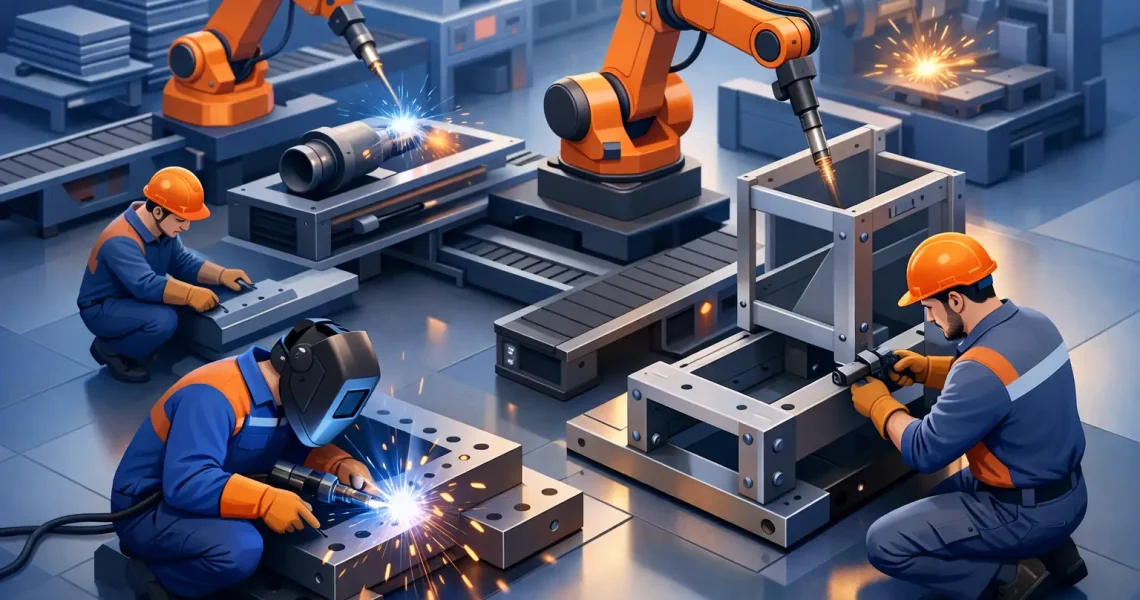
When a fabricated part moves from print to production, the real test is not just whether each component meets tolerance. It is whether the final assembly fits, performs, and holds up under operating conditions. That is where industrial welding and assembly services become a strategic advantage, especially for OEMs, contractors, and project teams managing complex builds with tight timelines.
For many industrial buyers, welding and assembly are still sourced as separate steps. One supplier cuts and forms. Another welds. A third handles sub-assembly or final fit-out. That model can work for simple jobs, but it often creates avoidable friction in projects that require repeatability, speed, and accountability. Every handoff introduces another variable – dimensional drift, communication gaps, lead time expansion, and unclear responsibility when something does not line up on the floor.
Why industrial welding and assembly services matter
In industrial manufacturing, welding is not an isolated process. It is tied directly to upstream material preparation, machining accuracy, bend consistency, fixture design, and downstream assembly requirements. A weldment that looks acceptable on a table can still create major problems if it distorts during joining, interferes with mating parts, or requires excessive rework during installation.
Assembly introduces another layer of complexity. Once hardware, machined features, brackets, frames, enclosures, tube sections, or custom components come together, tolerance stack-up becomes real. Parts that were acceptable individually may no longer perform as a complete unit if process control is weak. For buyers in sectors such as automation, semiconductor, aerospace support equipment, pharmaceutical systems, and electrical infrastructure, that risk is not theoretical. It affects commissioning, field installation, and long-term reliability.
That is why many procurement and engineering teams are moving toward suppliers that can manage fabrication, welding, and assembly under one roof. The goal is not simply convenience. It is better control over fit, sequence, quality, and schedule.
What strong industrial welding and assembly services should include
The value of industrial welding and assembly services depends on how well they are integrated into the broader manufacturing workflow. A capable supplier should be able to support the full path from raw material processing through finished assembly, rather than treating welding as a standalone trade service.
That starts with fabrication readiness. If laser cutting, CNC punching, machining, forming, and tube processing are completed in-house, parts arrive at welding stations with more consistent geometry and fewer unknowns. Welders and assemblers are not compensating for poor cut quality or inconsistent bends. They are working from controlled inputs.
It also depends on fixturing and production planning. Precision welding is not just about operator skill. It relies on proper joint preparation, clamping strategy, heat management, and sequence control. For assemblies with critical dimensions or machined interfaces, these details matter as much as the weld itself.
Assembly capability should extend beyond basic fastening. In many industrial applications, sub-assemblies require alignment checks, tapped features, inserts, brackets, electrical mounting provisions, machined interfaces, or prepared surfaces for downstream installation. A supplier that understands how fabricated parts function within the full system can reduce integration problems later.
The operational benefit of a single manufacturing partner
Industrial buyers are under pressure to reduce lead times while maintaining quality. Managing multiple vendors for fabrication, welding, and assembly often does the opposite. It creates more purchase orders, more freight coordination, more quality checkpoints, and more project risk.
A single manufacturing partner can simplify this significantly. Design feedback happens earlier. Fabrication choices can be made with welding requirements in mind. Assemblies can be built around realistic production conditions instead of idealized drawings. If revisions are needed, they can be implemented faster because the technical teams are already connected.
This model is especially useful for prototype-to-production programs. Early units may require design adjustments after test fitting or field review. When machining, forming, welding, and assembly are coordinated in one facility, those changes are easier to manage without losing momentum.
For purchasing teams, vendor consolidation also improves accountability. There is less ambiguity around where a dimensional issue started or who is responsible for correcting it. That matters when schedules are tight and the assembly is part of a larger delivery commitment.
Where welding quality affects downstream performance
Not all welded assemblies face the same service demands. A structural support frame has different requirements than a precision machine base, pharmaceutical enclosure, or semiconductor equipment bracket. Material type, wall thickness, joint design, cosmetic expectations, and end-use environment all influence the right welding approach.
This is why technical judgment matters. Overwelding can be as problematic as underwelding. Excess heat can distort thin-gauge sheet metal, shift critical surfaces, or compromise mating features. In other cases, the challenge is maintaining strength while preserving dimensional stability across repeated builds.
For assemblies that include machined components, tolerances become even tighter. Features created on mills, lathes, or EDM equipment often need to align precisely with welded structures. If the fabrication partner lacks both machining knowledge and welding discipline, the final assembly may require costly manual correction.
A well-equipped manufacturer approaches this differently. Welding is planned around the finished function of the part. Inspection is tied to fit and geometry, not just bead appearance. Assembly operations are sequenced to protect both structure and tolerance.
Industrial welding and assembly services for complex sectors
The demand for industrial welding and assembly services is highest in sectors where reliability, cleanliness, and repeatability are non-negotiable. Automation systems require frames, machine guards, brackets, and integrated assemblies that align correctly the first time. Electrical and industrial infrastructure projects depend on fabricated enclosures, mounting systems, and support structures that install without modification.
In semiconductor and pharmaceutical environments, the expectation is often higher still. Fabricated components may need precision finishing, clean geometry, and strict dimensional consistency to support sensitive equipment or controlled production areas. Aerospace support applications add another layer of scrutiny, where structural integrity and repeatable fabrication standards are essential.
These are not jobs that benefit from a fragmented supply chain. They benefit from a partner with process depth, broad machinery capacity, and a clear understanding of how fabricated assemblies are used in the field.
How buyers should evaluate a welding and assembly supplier
Price matters, but it should not be the only filter. The lowest quote can become the highest total cost if it leads to rework, missed installation windows, or repeated engineering intervention.
A more useful evaluation starts with process alignment. Can the supplier support cutting, forming, machining, welding, and assembly in a coordinated workflow? Do they have experience with your material types, tolerances, and production volumes? Can they build one-off custom assemblies as effectively as repeat production runs?
It is also worth looking at production readiness. A supplier may produce acceptable samples but still struggle with repeatability if fixturing, inspection discipline, or capacity planning are weak. Buyers should look for evidence of controlled execution, not just broad service claims.
Responsiveness is another practical factor. Industrial projects change. Drawings are revised, interfaces shift, and installation conditions reveal new constraints. A capable partner does not just fabricate to print. They help identify issues early and respond quickly when technical adjustments are needed.
That is where a full-service manufacturer brings real value. Companies such as LUX METAL support turnkey metal fabrication with in-house machining, forming, welding, and assembly capabilities, giving engineering and procurement teams a more controlled path from concept to finished product.
When integrated service is the better choice
There are cases where separate vendors still make sense. If a project is highly standardized, low risk, and based on simple parts with generous tolerances, splitting the work may be manageable. Some buyers also maintain long-standing supplier networks that fit their internal processes.
But for custom metal projects, engineered assemblies, and high-mix production environments, integration usually wins. The more demanding the specification, the more valuable it becomes to work with a supplier that can control the entire process chain. This is particularly true when the final product includes fabricated structures, precision-machined features, and assemblies that must install or perform without adjustment.
The strongest industrial welding and assembly services are not defined by welding alone. They are defined by how well every upstream and downstream process supports the final build. That includes design interpretation, material handling, fabrication accuracy, joining control, assembly sequence, and production discipline.
If your project involves tight tolerances, multiple fabrication steps, or mission-critical assemblies, the right manufacturing partner can remove more risk than any line-item price reduction ever will. The best result is not just a welded part that ships on time. It is an assembly that arrives ready to perform.