
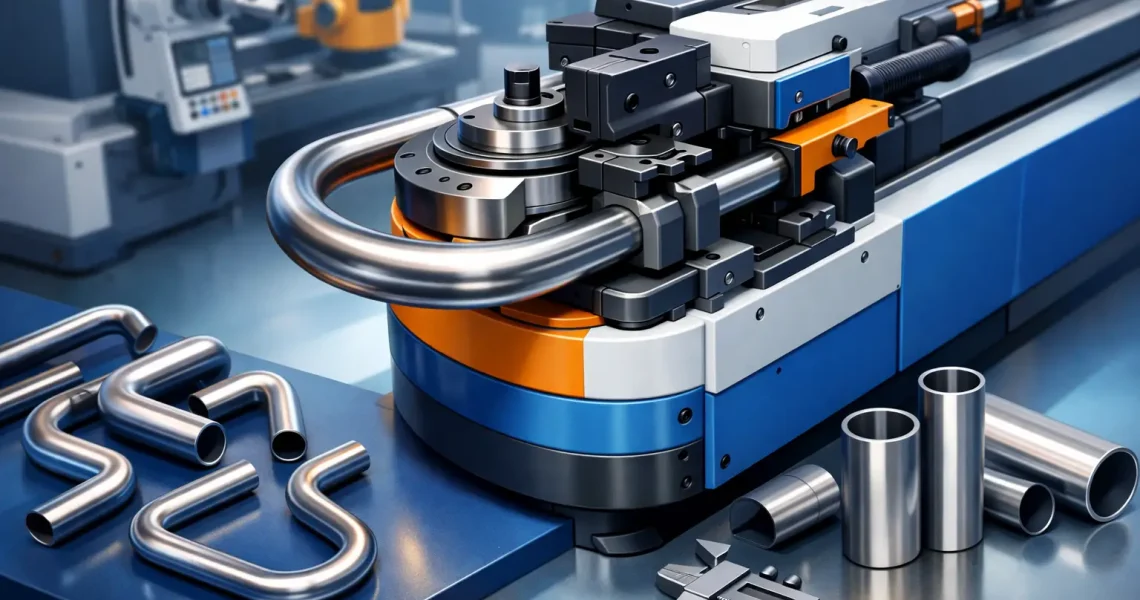
When a tube assembly reaches final installation and one bend is off by a few degrees, the problem rarely stays isolated. Mounting points miss alignment, downstream welding takes longer, cosmetic quality drops, and field adjustments start eating into schedule and budget. That is why cnc tube bending services matter most when the part has to fit the first time, not after rework.
For OEMs, contractors, and industrial buyers, tube bending is not just a forming step. It affects assembly accuracy, structural performance, routing efficiency, and production repeatability. In sectors like automation, electrical equipment, semiconductor systems, pharmaceutical machinery, and construction, the tolerance expectations are high and the margin for variation is small.
What CNC Tube Bending Services Actually Deliver
CNC tube bending services use programmed equipment to form tube and pipe into repeatable shapes with controlled bend angles, radii, and orientation. The value is not simply automation. It is consistency across prototypes, pilot runs, and full production volumes.
A properly controlled CNC bending process helps maintain dimensional accuracy while reducing distortion that can interfere with downstream assembly. That matters when parts must align with brackets, enclosures, machined interfaces, or welded frames. It also matters when tube paths are designed around tight spaces, cable routing, fluid transfer, or guarding structures.
For many projects, the real advantage is integration. Bent tubes are rarely standalone parts. They often move directly into welding, machining, laser cutting, assembly, or installation. When those operations are coordinated under one manufacturing partner, communication gaps shrink and revisions move faster.
Where Tube Bending Precision Has the Biggest Impact
Tube bending requirements vary by application, and the best process depends on what the part needs to do after forming. A support frame for industrial equipment has different priorities than a cosmetic stainless assembly or a thin-wall routed tube used in a machine interior.
In structural and load-bearing applications, consistency in bend geometry supports overall part strength and fit-up. In mechanical systems, bend positioning affects clearance, fastening, and interface with adjacent components. In visible commercial installations, the finish and contour quality matter almost as much as dimension.
This is where engineering review becomes critical. Material type, wall thickness, bend radius, tube diameter, springback, and final-use environment all influence the forming approach. Tight radii may be possible, but not every design choice is equally stable or cost-effective in production. Sometimes a small design adjustment improves manufacturability without changing function.
Choosing CNC Tube Bending Services for Custom Work
Not all cnc tube bending services are set up for the same type of work. Some shops are geared toward simple, high-volume parts with standard geometries. Others are built for custom fabrication, where tube bending is one step inside a larger production scope.
For industrial buyers, that difference matters. If your project includes bent tubes plus welded assemblies, machined features, cut sheet metal, fixtures, or installation-ready subassemblies, a single-process vendor can create extra coordination work. You may save on one operation and lose time across the rest of the job.
A stronger fit is a manufacturing partner that can review the part in context. That means looking at tolerances, mating components, finishing requirements, and how the bend sequence affects later operations. It also means understanding whether the project is a one-off prototype, an engineering validation run, or a recurring production order.
Capacity matters too. The ideal supplier should be able to support both development-stage adjustments and repeatable output once the design is locked. That flexibility is especially useful for OEMs and project teams managing evolving specifications.
Material, Geometry, and Tolerance Trade-Offs
Tube bending always involves trade-offs. Buyers who understand them early tend to avoid costly revisions later.
Material is the first factor. Mild steel, stainless steel, aluminum, and other alloys each respond differently during bending. Some materials are more forgiving. Others are more prone to springback, surface marking, or wall deformation. If the part will be welded, polished, coated, or used in a regulated environment, material behavior during bending has to be considered alongside end-use requirements.
Geometry is next. The tighter the bend radius relative to tube diameter and wall thickness, the more challenging the operation can become. Complex multi-plane bends increase difficulty further because rotation and orientation control become more critical. These parts are achievable, but they demand process discipline and accurate programming.
Tolerance is where expectations need to match function. Some applications justify very tight tolerances because the tube interfaces directly with precision components. In other cases, over-specifying tolerances increases cost without improving performance. A capable fabrication partner will flag that distinction instead of simply quoting to print and letting problems surface later.
Why In-House Capabilities Improve Results
Tube bending performs best when it is connected to the rest of the manufacturing workflow. If a part must be cut, bent, welded, machined, marked, assembled, and inspected, each handoff adds risk. Small interpretation differences between vendors can create dimensional drift, finish issues, or schedule delays.
In-house capability reduces that exposure. When fabrication teams can manage multiple processes under one roof, the part is evaluated as a complete assembly rather than a series of isolated tasks. Bend allowances, cut lengths, welding access, fixture design, and installation requirements can be reviewed together.
This is particularly valuable for custom industrial projects where revisions are common. A design update to one bracket or mounting interface may require a change in tube length, bend location, or assembly sequence. With integrated production resources, those adjustments can be controlled faster and with fewer communication loops.
For buyers trying to consolidate vendors, this approach also simplifies procurement. Instead of managing separate suppliers for forming, machining, welding, and assembly, the project can move through a coordinated production path. That saves administrative time and usually improves accountability.
CNC Tube Bending Services in High-Spec Industries
The demand for tube bending quality becomes sharper in technical industries. In semiconductor and pharmaceutical equipment, for example, clean layouts, precise routing, and reliable dimensional control are often necessary to support system integration. In automation, bent tube components may function as guards, frames, supports, or structural carriers that must align with machined and fabricated assemblies.
In aerospace and electrical applications, consistency is equally important, though the requirements may differ. One project may prioritize weight, another corrosion resistance, another assembly precision across repeated batches. Construction-related work can bring larger-format parts, practical durability requirements, and installation constraints that need to be addressed before production starts.
These are not identical markets, so the right process is rarely one-size-fits-all. What matters is whether the supplier understands how tube bending interacts with the standards, tolerances, and operating conditions of the end-use sector.
What to Look for in a Tube Bending Partner
Buyers evaluating cnc tube bending services should look beyond basic equipment lists. Machinery is important, but execution is what determines whether the final part performs as intended.
A reliable partner should be able to review drawings and models with a manufacturing lens, identify potential bend issues before production, and recommend practical adjustments when needed. Repeatability, inspection discipline, and responsiveness during revision cycles are just as important as forming capability itself.
It also helps to work with a supplier that understands complete metal fabrication. LUX METAL supports custom projects with tube bending alongside laser cutting, CNC machining, welding, assembly, and broader turnkey fabrication work. For customers managing complex assemblies or production programs, that broader scope can reduce lead time pressure and simplify project control.
From Prototype to Production
The requirements for a prototype are not always the same as the requirements for a stable production part. Early-stage work often prioritizes speed and functional validation. Production work prioritizes repeatability, process control, and predictable output at volume.
A capable tube bending supplier should support both stages without forcing a disconnect between development and manufacturing. That means refining the process as the design matures, documenting critical parameters, and preparing the job for efficient repeat runs.
For engineers and procurement teams, this continuity has real value. It reduces the chance that a prototype can be made but not produced reliably at scale. It also gives stakeholders a clearer view of cost drivers before the project reaches full release.
The best cnc tube bending services do more than form metal to shape. They help ensure the part fits the assembly, supports the application, and moves through production with fewer surprises. If your next project includes bent tube components with tight tolerances, multi-process fabrication needs, or demanding industry requirements, the right manufacturing partner should be able to solve the whole job, not just the bend.