
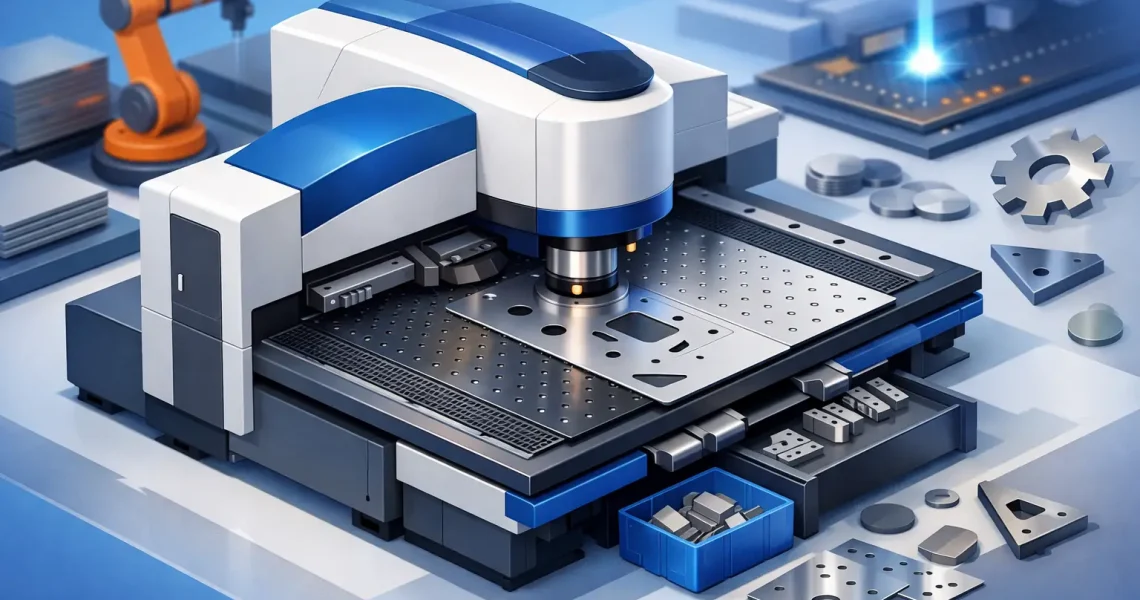
When a project needs formed features, repeatable hole patterns, and production speed without adding unnecessary secondary work, a cnc turret punching service is often the right fit. For OEMs, contractors, and fabrication buyers, the value is not just in cutting sheet metal. It is in producing functional parts faster, with consistent accuracy, and with features that support assembly, fastening, airflow, cable routing, and enclosure performance.
Turret punching is especially effective when part geometry includes many holes, slots, louvers, embosses, countersinks, knockouts, or other standard features that can be produced directly in the sheet. In the right application, it reduces handling, shortens lead times, and improves cost control across both prototype and repeat production.
What a cnc turret punching service actually delivers
A CNC turret punch press uses programmed tool stations to punch, form, and shape sheet metal with high repeatability. Unlike processes that only cut the profile, turret punching can create part features during the same operation. That matters in production environments where every additional setup adds time, cost, and the chance for variation.
For industrial buyers, the real advantage is practical. A well-run cnc turret punching service can produce panels, brackets, covers, electrical enclosures, machine guards, mounting plates, trays, and chassis components with feature-rich layouts at production speed. The process is well suited for carbon steel, stainless steel, aluminum, and other common sheet materials used in commercial and industrial assemblies.
This is not the right answer for every geometry. Very thick plate, highly intricate decorative contours, or designs with extensive freeform cutting may be better served by other processes. But for many engineered sheet metal components, turret punching offers a strong balance of speed, feature flexibility, and part-to-part consistency.
Where cnc turret punching service fits best
The strongest applications share a common pattern. They require sheet metal parts with repeated internal features, moderate to high quantities, and dependable dimensional control. Electrical panels are a good example because they often include perforations, mounting holes, ventilation patterns, and hardware-ready features. Equipment housings and automation components also fit well because they depend on precise alignment during assembly.
In sectors such as semiconductor, pharmaceutical equipment, automation, aerospace support equipment, and construction systems, production needs are rarely simple one-process jobs. A punched part may also need bending, welding, machining, surface marking, or final assembly. That is where buyers benefit from working with a fabrication partner that can manage the complete sequence instead of handing the part from one vendor to another.
This is one of the main commercial reasons companies consolidate fabrication services. The savings are not only on unit price. They come from fewer logistics steps, cleaner communication, tighter revision control, and faster response when a design needs adjustment.
Speed matters, but so does feature strategy
Turret punching is often chosen for speed, and rightly so. Once tooling and programming are aligned to the design, production can move quickly. However, speed alone is not what separates a capable supplier from a basic one. The difference is whether the part is engineered for the process.
A part with dozens of holes may look straightforward in a drawing, but production efficiency depends on tool selection, material behavior, sheet utilization, feature spacing, burr control, and downstream forming requirements. Small changes in layout can improve tool access, reduce marking, and support better flatness after processing.
That is why early technical review matters. Engineers and procurement teams usually get the best outcome when manufacturability is discussed before release, not after the first batch exposes avoidable issues. A supplier with broader sheet metal and machining capability can flag those issues early because they understand how the punched part will behave in later fabrication stages.
Cost advantages and trade-offs
A cnc turret punching service can be highly cost-effective, particularly for parts with repetitive features. Standard tooling allows common shapes and hole sizes to be produced efficiently, and forming features in-process reduces secondary operations. In a production setting, those gains add up quickly.
Still, the economics depend on the part. If the design relies on many unusual contours or custom shapes that fall outside standard tool options, another process may make more sense. If cosmetic edge quality is the top priority on a visible architectural panel, process selection may depend on finish requirements as much as throughput. If the quantity is very low and the geometry is complex, there may be a different best-fit method.
This is where objective process matching matters. Good fabrication planning is not about forcing every part into one machine. It is about selecting the method that gives the required function, tolerance, finish, and lead time at a sensible cost.
Quality depends on more than the punch press
Buyers sometimes evaluate turret punching as if machine capacity alone determines quality. It does not. The press is only part of the equation. Material condition, programming discipline, tooling maintenance, operator experience, inspection routines, and downstream process control all affect the final result.
For example, a punched enclosure panel may meet hole location requirements but still create assembly problems if formed features distort the surface or if bend references are not managed correctly. Likewise, a bracket may appear dimensionally acceptable in isolation but fail during installation if punched features do not align with machined or welded interfaces.
This is why integrated quality control is so important for fabricated metal components. Repeatability is not only about making the same punched blank twice. It is about making parts that fit, fasten, and perform correctly when they reach the next production stage.
From prototype to production without changing suppliers
One of the common challenges in industrial sourcing is the gap between prototype capability and production readiness. A supplier may be able to produce sample parts, but struggle when the program moves into repeat manufacturing, assembly integration, or schedule-critical delivery.
A stronger cnc turret punching service supports both stages. Prototypes help validate fit and function. Production then requires stable programming, documented process control, material planning, and the flexibility to scale quantities without losing consistency. That transition is smoother when the same partner handles punching alongside bending, welding, machining, marking, and assembly preparation.
For customers managing complex equipment builds, that continuity reduces risk. It also improves accountability because one manufacturing team owns the part through multiple stages rather than isolating responsibility by process.
What to look for in a supplier
Industrial buyers usually have a good sense of machine capability. The more revealing questions are operational. Can the supplier review drawings and recommend process improvements? Can they hold tolerances that matter to the assembly, not just the flat pattern? Can they support both simple and complex mix production? Can they combine turret punching with machining, forming, and welded fabrication under one roof?
It also helps to ask how they handle revisions, first article approval, and part traceability when required. In many industries, responsiveness is as valuable as technical equipment. Delays often come from unclear communication, fragmented production planning, or poor change control rather than from machine uptime alone.
A dependable partner should be able to discuss material suitability, feature feasibility, tolerance interaction, and downstream fabrication impact in direct terms. That level of engagement is what turns a supplier into a practical extension of the customer’s engineering and operations team.
Why integrated fabrication makes turret punching more valuable
On its own, turret punching is a strong process. As part of a broader manufacturing workflow, it becomes more valuable. A punched component often moves immediately into bending, hardware insertion, machining, welding, finishing, or assembly. If those steps are coordinated internally, production moves faster and with fewer avoidable discrepancies.
That is particularly relevant for custom industrial work where no two jobs are identical. A simple panel may become part of a larger enclosure. A bracket may require precision-machined interfaces. A cover may need laser marking and final installation support. LUX METAL approaches these requirements as part of turnkey metal fabrication, not as isolated process transactions.
For buyers under pressure to simplify sourcing, that model makes sense. It reduces vendor handoffs while keeping technical ownership in one place.
The best cnc turret punching service is not simply the one that can hit the sheet the fastest. It is the one that understands the part, the assembly, and the production target well enough to turn a drawing into reliable output without creating problems downstream. When that alignment is in place, punching becomes more than a fabrication step. It becomes a production advantage.