
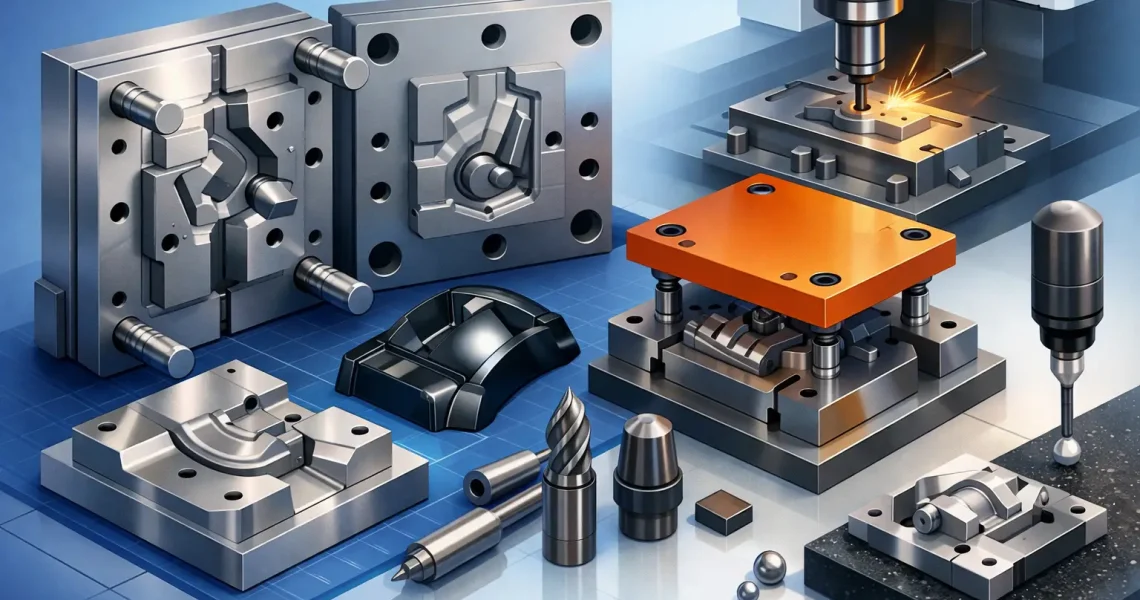
A tooling issue rarely starts on the production floor. It starts earlier – in the way the tool was designed, machined, fit, and validated for the actual part, material, and cycle demands. That is why custom molds and dies fabrication matters so much in industrial manufacturing. When tooling is built around real tolerances, real throughput targets, and real downstream constraints, production runs more predictably.
For OEMs, contract manufacturers, and project teams managing tight schedules, a mold or die is not just a piece of tooling. It is a production asset. It affects part quality, scrap rate, setup time, maintenance frequency, and the ability to scale from first article to repeat orders. A fabrication partner needs to understand that broader production role, not just the geometry on a drawing.
What custom molds and dies fabrication actually involves
Custom molds and dies fabrication is the engineering and manufacturing of tooling built for a specific part, forming process, or production environment. That can include stamping dies, forming dies, trimming dies, progressive dies, injection mold components, jigs, fixtures, and precision tooling inserts. The common requirement is simple: the tool must perform consistently under real operating conditions.
That sounds straightforward until project variables stack up. Material behavior changes how a die wears. Part geometry affects release, alignment, and repeatability. Tolerance requirements drive machining strategy, inspection planning, and finishing work. If the tool also needs to integrate into existing equipment, the fabrication scope becomes even more specialized.
A capable fabrication process usually begins with design review, manufacturability assessment, and material selection. From there, machining, EDM, wire cutting, grinding, fitting, and assembly must be coordinated carefully. In many projects, toolmaking is less about one impressive process and more about controlling every handoff between processes.
Why tooling quality drives production performance
When buyers evaluate tooling cost, the lowest upfront quote can look attractive. But molds and dies are not isolated purchases. They influence total production cost over time. A poorly built die may cause burrs, misalignment, inconsistent forming, or premature wear. A mold with weak dimensional control may create recurring part variation that forces secondary work or rejects.
Good tooling reduces those problems before they become operational losses. It supports stable cycle times, cleaner part output, and more predictable maintenance intervals. That matters in high-volume environments, but it matters just as much in low-to-medium volume work where downtime can disrupt the entire job schedule.
There is also a practical procurement issue here. If multiple vendors are involved in design, machining, fitting, and production troubleshooting, accountability gets blurred quickly. A full-service manufacturing partner can shorten that chain. When design feedback, CNC machining, EDM, forming knowledge, and assembly support sit under one roof, revisions move faster and root-cause analysis becomes more direct.
Key processes used in custom molds and dies fabrication
The tooling itself may be custom, but the execution depends on disciplined process selection. CNC milling and lathe turning are central for producing high-tolerance cores, cavities, die blocks, punches, retainers, and support components. These processes establish geometry, mating features, and surface accuracy where repeatability is critical.
EDM and wire cutting become essential when features are intricate, internal corners are tight, or hardened materials make conventional machining less practical. These processes are often what make demanding tool geometries possible without compromising dimensional control. For stamping and forming applications, precision machining must also account for clearance, springback, and wear zones that affect tool life.
Fabrication work around the tooling can matter just as much as the precision inserts themselves. Bases, frames, holders, guides, and machine interface components all need accurate fabrication and alignment. In more complex programs, the value comes from combining machining with sheet metal fabrication, welding, assembly, and commissioning support rather than sourcing each piece separately.
Material selection is never just a purchasing decision
Tool steel selection affects far more than cost per block. It influences hardness, machinability, wear resistance, thermal behavior, maintenance strategy, and expected tool life. The right choice depends on the application, production volume, and failure mode the tool is most likely to face.
For example, a tool built for abrasive material or repeated high-load cycles may need greater wear resistance and heat treatment control than a lower-volume fixture or prototype die. On the other hand, specifying a higher-grade material than the application requires can add machining complexity and cost without creating meaningful production value.
This is one of the most common areas where engineering judgment matters. The best result is not always the hardest material or the most expensive one. It is the material that matches the actual operating environment and can be manufactured, finished, and maintained efficiently.
Where projects succeed or fail
Most tooling delays do not come from one catastrophic mistake. They come from small misses in communication and process planning. A drawing may define nominal dimensions without fully addressing tolerance stack-up. A production team may specify output targets without sharing maintenance limitations. An existing machine interface may constrain tool size, clamping, or access more than expected.
That is why early technical review is so important. Before fabrication begins, the toolmaker should understand the part function, material type, production method, expected volume, inspection criteria, and any downstream assembly requirements. In regulated or high-spec industries such as semiconductor, pharmaceutical, aerospace, and automation, that upfront clarity becomes even more important because tolerance and traceability expectations are higher.
The strongest fabrication partners ask practical questions early. How will the tool be loaded and serviced? What wear surfaces are most exposed? Which dimensions are critical to function versus critical to fit? Is this a prototype tool that needs speed, or a long-run production tool that needs maximum durability? Those distinctions shape the entire manufacturing approach.
Choosing a custom molds and dies fabrication partner
For B2B buyers, vendor selection should go beyond whether a supplier can machine hardened steel. The better question is whether the supplier can take ownership of the complete tooling outcome. That includes engineering review, process planning, precision machining, fitting, assembly, inspection, and support after delivery.
Capacity matters. So does range. A partner with in-house CNC machining, EDM, wire cutting, fabrication, welding, and assembly can usually control schedule and quality more effectively than a vendor network built around subcontracting. That does not mean every project must be done entirely in-house, but it does reduce handoff risk on complex jobs.
Responsiveness is another factor that procurement teams often underrate until a project changes midstream. Custom tooling rarely moves in a perfectly straight line. Design revisions happen. Production feedback arrives late. Urgent repairs appear at the worst time. A partner with broad technical capability can adapt faster because the people reviewing the problem are close to the machines and the work.
At LUX METAL, that full-scope approach is central to how complex metal projects are executed – from design review and precision machining through fabrication, assembly, and production support.
What buyers should prepare before requesting a quote
A good RFQ for tooling should include more than part drawings. The more useful inputs are the ones that explain how the tool will be used. Production volume, material specification, machine compatibility, tolerance priorities, expected maintenance intervals, and any known failure points all improve quoting accuracy.
If there is an existing tool, share what is not working. Premature wear, alignment drift, part sticking, dimensional inconsistency, and setup inefficiency are valuable clues. They help the fabrication team avoid repeating the same design limitations in a new build.
It also helps to be clear about whether the project is a prototype, bridge tool, repair, or full production program. The right solution depends on that context. Fast turnaround may matter more than maximum life in one case, while another project justifies more extensive engineering and higher-grade materials for long-term stability.
Custom molds and dies fabrication works best when the tool is treated as part of the production system, not as a standalone item to source as cheaply as possible. The right build should fit the process, support the part, and reduce friction across manufacturing. When that happens, the value shows up where it counts most – in uptime, consistency, and fewer surprises after the tool hits the floor.