
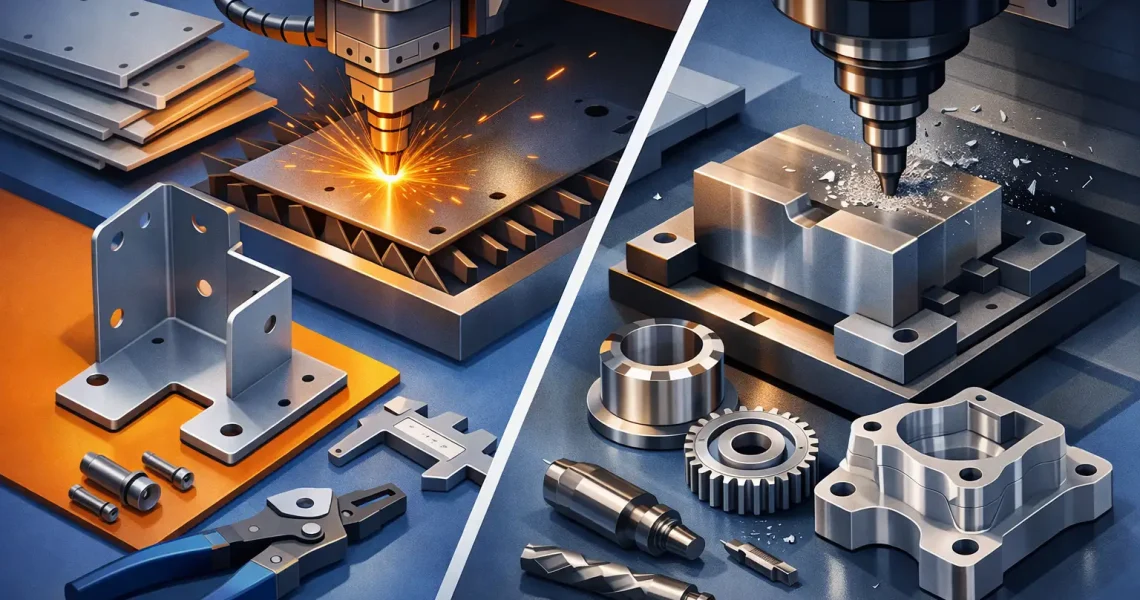
A part looks simple on a drawing until the quote comes back with the wrong process behind it. That is where sheet metal fabrication vs machining becomes a real commercial and engineering decision, not just a manufacturing definition. For OEMs, contractors, and project teams, the right choice affects lead time, tolerances, assembly fit, material yield, and total project cost.
The two processes solve different problems. Sheet metal fabrication starts with flat stock and transforms it through cutting, punching, bending, rolling, welding, and assembly. Machining removes material from solid stock or preformed blanks using mills, lathes, EDM, and other precision equipment to create tight-tolerance features and complex geometries.
If your team is sourcing custom components, the best question is not which process is better. The better question is which process fits the part, the quantity, the tolerance requirement, and the downstream assembly.
What sheet metal fabrication does best
Sheet metal fabrication is built for parts and assemblies made from flat material that can be cut and formed efficiently. Enclosures, brackets, guards, panels, cabinets, frames, covers, and welded sheet metal assemblies are common examples. When a design can be developed from a flat pattern and formed into shape, fabrication often delivers the most efficient route.
The cost advantage usually comes from material utilization and processing speed. Laser cutting and turret punching can produce profiles quickly. Press brake forming creates repeatable bends with good consistency. Welding and assembly complete the build without requiring the entire part to be carved from a solid block of metal.
For medium to high volumes, fabricated parts often become even more competitive because cycle times are lower once the process is set. This matters for industrial programs where lead time and repeatability carry as much weight as piece-part price.
Sheet metal fabrication also supports larger parts more naturally than machining in many cases. A large equipment cover or structural housing may be impractical or unnecessarily expensive to machine from billet. Fabricating that same item from sheet and formed sections usually makes far more sense.
Where machining has the advantage
Machining is the stronger option when part geometry depends on precise material removal rather than forming. If the component needs critical bores, tight flatness, threaded features, milled pockets, turned diameters, or fine surface finishes, machining is often the correct process.
This is especially true for high-tolerance parts used in semiconductor equipment, automation systems, tooling, jigs, fixtures, molds, and precision assemblies. A machined component can hold dimensional requirements that sheet metal fabrication cannot reasonably achieve on its own.
Machining also gives engineers more freedom with part thickness and three-dimensional geometry. A part with multiple datum-controlled surfaces, concentricity requirements, or detailed internal features is usually a machining job from the start. Trying to force that part into a sheet metal approach can create unnecessary complexity, secondary operations, and quality risk.
For low-volume custom components, machining can also be practical because setup is straightforward compared with fabricating a multi-operation welded assembly. If a part is small, thick, and feature-heavy, machining may be faster to produce even if the raw material cost is higher.
Sheet metal fabrication vs machining in cost
Cost is where many sourcing decisions begin, but it should not be reduced to hourly rate alone. The real cost difference comes from how each process uses material, labor, machine time, fixturing, and secondary operations.
Sheet metal fabrication tends to be more cost-effective for parts that can be nested on flat stock and formed with minimal rework. You are using only the material the design needs, then shaping it efficiently. For housings, covers, simple brackets, and welded assemblies, that can create a strong cost position.
Machining often carries a higher material and cycle-time burden because the process removes stock to reach final geometry. If you start with a thick billet and machine away a large percentage of it, the scrap and spindle time add up quickly. That does not make machining inefficient by default. It simply means the process has to be justified by the geometry and tolerance requirements.
There is also an important crossover point. A fabricated design with too many welds, inserts, tight bend relationships, and secondary machining can become more expensive than a smartly machined alternative. In other words, poor design for fabrication can erase the expected savings.
Tolerances and precision requirements
Tolerance is one of the clearest dividing lines in sheet metal fabrication vs machining. Fabrication can hold good production tolerances, especially with quality laser cutting, CNC forming, and disciplined process control. But formed sheet metal still behaves like formed material. Springback, heat input from welding, and stack-up across assemblies all influence the final result.
Machining is typically the better path when tolerances are critical to function rather than just fit. Precision holes, bearing seats, mating faces, alignment features, and close-tolerance profiles belong in a machining environment. This is why many industrial products combine both methods: fabricated structure where efficiency matters, machined features where precision matters.
That hybrid approach is often the smartest route. A fabricated frame may provide the main body, while machined inserts, mounting plates, or critical interfaces handle the precision requirements. This avoids overengineering the full assembly around one process.
Geometry decides more than preference
Part shape should guide process selection early. If the design is essentially a flat pattern with bends, cutouts, louvers, tabs, and welded joins, sheet metal fabrication is the natural fit. If the design is a solid form with pockets, contours, holes at multiple depths, and turned or milled surfaces, machining is more appropriate.
Thickness is another clue. Thin to moderate gauge materials are ideal for sheet metal work. As thickness increases, forming becomes more demanding and design flexibility changes. At some point, the part begins behaving less like a sheet metal component and more like a machined one.
Feature placement matters too. A simple enclosure with standard bend radii is easy to fabricate. An enclosure with unusually tight bend spacing, cosmetic surface demands, and machined-level positional tolerances on every feature is not. Good engineering review will catch these conflicts before they turn into delays on the shop floor.
Production volume and lead time
Fabrication and machining respond differently to production volume. Sheet metal fabrication often scales well for repeat programs, especially when the part family shares similar material and setup conditions. Once flat patterns, tooling strategy, and weld fixtures are established, production can move efficiently.
Machining is excellent for prototypes and precision short runs because it can produce complete parts directly from CAD-driven programs with limited hard tooling. For small quantities of complex parts, this flexibility is a major advantage.
Lead time depends on more than the process itself. It depends on whether one supplier can manage cutting, forming, machining, welding, finishing, and assembly in sequence without outside handoffs. That is often where delays start. A multi-process manufacturing partner can shorten schedules simply by reducing coordination points.
When the right answer is both
Many real-world projects are not sheet metal fabrication vs machining in an either-or sense. They are a combination of both. A machine enclosure may be fabricated from laser-cut and formed panels, then paired with machined brackets, alignment blocks, and precision mounting features. An automation assembly may use fabricated guards and frames alongside machined tooling plates and turned shafts.
This matters for procurement and project management because process integration affects quality and scheduling. When fabrication and machining are developed together, tolerances can be allocated intelligently, assemblies can be simplified, and unnecessary vendor overlap can be removed.
For industrial buyers, that usually means better control over revisions, fewer fit-up problems during assembly, and clearer accountability when the job moves from prototype to production.
How to choose the right process early
The best decisions happen before release to production. Start with four questions. What function does the part serve? Which dimensions are truly critical? How many units are required? What secondary operations will follow, including welding, finishing, and installation?
If the part mainly encloses, supports, protects, or mounts and can be built from flat stock, sheet metal fabrication should be evaluated first. If the part drives alignment, motion, sealing, or precision fit, machining deserves closer attention.
It also helps to involve a manufacturing partner early enough to challenge assumptions. A minor design revision such as changing material thickness, moving a bend, splitting an assembly, or machining only the critical surfaces can significantly improve cost and manufacturability. That is where broad in-house capability becomes valuable. A partner with both fabrication and precision machining capacity can recommend the process based on performance and production logic, not on the limits of a single department.
For teams sourcing custom metal parts, the smartest choice is rarely the most familiar one. It is the one that matches geometry, tolerance, volume, and assembly demands with the least friction across the full build. If you evaluate the part that way from the start, the process selection becomes clearer and the project usually moves faster.