
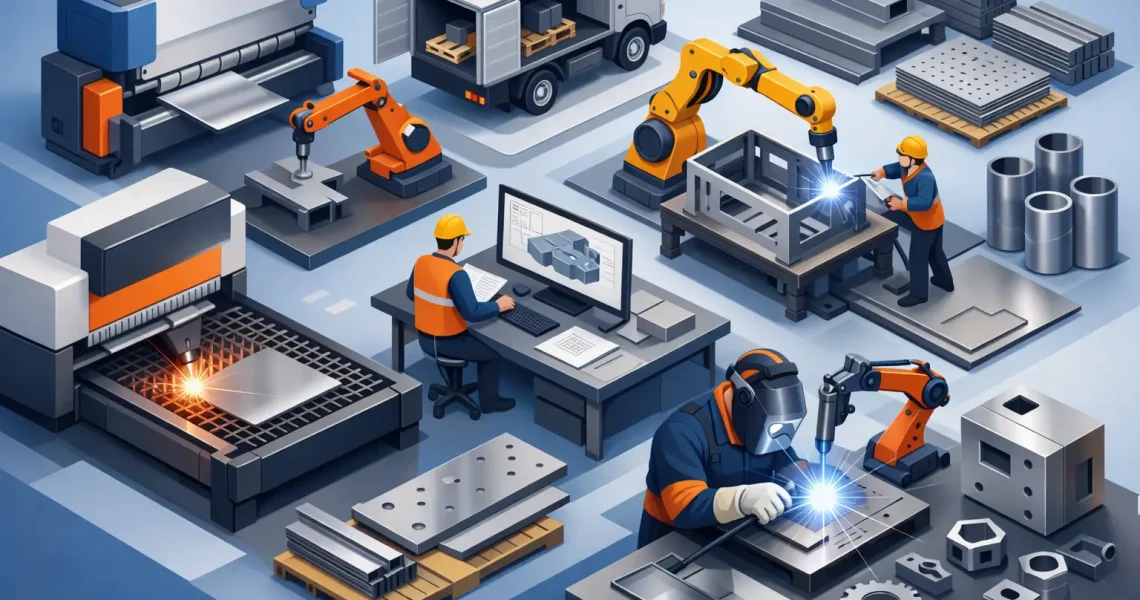
When a project requires laser cutting, CNC machining, welding, assembly, and on-site installation, the real challenge is rarely a single process. It is coordination. A turnkey metal fabrication company solves that problem by managing the full manufacturing scope under one roof or through one accountable partner, reducing handoff risk and keeping technical decisions aligned from design through commissioning.
For OEMs, contractors, integrators, and procurement teams, that model can change the economics of a project. It affects lead times, quality control, revision management, and the amount of internal effort needed to get a complex build across the finish line. The value is not just convenience. It is tighter execution on parts and assemblies that cannot afford mismatch, delay, or avoidable rework.
What a turnkey metal fabrication company actually provides
A standard job shop usually performs one or two core processes. That can work well for simple part runs or buyers with strong internal manufacturing oversight. A turnkey metal fabrication company takes a different role. It handles multiple stages of production as one integrated scope, often including design support, material sourcing, sheet metal fabrication, CNC machining, welding, surface finishing, assembly, installation, and final commissioning.
That broader scope matters most when parts need to fit into larger systems, when tolerances stack across several operations, or when the finished deliverable is more than a flat component. Enclosures, machine frames, automation assemblies, semiconductor fixtures, pharmaceutical support structures, electrical cabinets, and fabricated machine parts often require this level of coordination.
In practical terms, the buyer is not purchasing disconnected operations. The buyer is purchasing an outcome. That may be a fully assembled machine base, a production-ready welded and machined frame, or a custom metal solution that arrives ready for integration.
Why buyers choose turnkey metal fabrication
The biggest reason is accountability. When several vendors each own a different process, problems can become difficult to trace. If a machined feature does not line up after welding, or an assembly issue appears during installation, each supplier may point to a prior step. That slows resolution and creates cost exposure.
With turnkey fabrication, one partner owns the full chain of execution. Design assumptions can be reviewed against real manufacturing constraints. Machining allowances can be planned around forming and weld distortion. Assembly requirements can shape fabrication decisions early instead of becoming expensive corrections later.
This approach also reduces administrative drag. Procurement teams issue fewer POs. Project managers spend less time chasing status across multiple suppliers. Engineers work with a team that already understands how one process affects the next. On complex builds, that compression of communication is often as valuable as the production itself.
There is a trade-off. A turnkey partner must have genuine process depth, not just a broad service list. If the provider lacks in-house capability, technical oversight, or disciplined quality control, the promised simplicity can become a bottleneck. Turnkey works best when the supplier has proven capacity across fabrication, machining, assembly, and project management.
Where a turnkey metal fabrication company adds the most value
Not every job needs a full-service partner. If you need a straightforward batch of brackets with a stable print and no downstream assembly, a single-process supplier may be enough. Turnkey becomes more valuable as project complexity increases.
It is especially useful when parts move through several manufacturing stages and must maintain high tolerance throughout. Aerospace subcomponents, automation frames, cleanroom equipment, semiconductor tooling, pharmaceutical machine parts, and electrical infrastructure assemblies often fall into this category. These applications demand more than raw capacity. They require process planning.
It also makes sense when schedules are compressed. Multi-vendor projects can look competitive on paper, but they lose time in transport, queueing, approval cycles, and issue escalation. A qualified turnkey partner can overlap planning, fabrication, machining, and assembly in ways that are harder to manage across separate suppliers.
For buyers consolidating vendors, the model is even more attractive. Fewer vendors means fewer qualification cycles, fewer communication gaps, and a clearer path to repeatability once a design moves from prototype to production.
Key capabilities to look for in a turnkey metal fabrication company
Capability breadth is the starting point, but it is not the whole evaluation. A serious turnkey provider should be able to support both fabrication and precision machining, because many assemblies depend on the relationship between formed, welded, and machined features.
For sheet metal and structural work, that usually includes laser cutting, CNC turret punching, forming, rolling, tube bending, and welding. For precision work, it often includes milling, lathe turning, wire cutting, EDM, and secondary processes such as laser marking. If your application involves tooling, fixtures, molds, or high-accuracy custom parts, those machining capabilities matter even more.
Beyond equipment, look at engineering involvement. Can the supplier review prints for manufacturability? Can they recommend tolerance adjustments, material options, or assembly changes that improve yield without compromising function? The strongest turnkey partners do not wait for problems to show up on the shop floor.
Quality systems are another differentiator. Inspection planning, revision control, documented processes, and dimensional verification become critical when one supplier is responsible for multiple operations. A missed detail early in fabrication can multiply through machining and final assembly.
How turnkey execution improves project control
The strongest advantage of turnkey fabrication is that it aligns decisions that are usually fragmented. That alignment starts before cutting the first piece of metal. Engineering, fabrication, machining, and assembly teams can review the same job as one production flow instead of isolated tasks.
That reduces common failure points. Material selection can be matched to forming behavior and end-use conditions. Weld sequences can be planned to protect critical tolerances. Machining can be staged after stabilization steps where needed. Assembly access and installation requirements can be considered before a part is released to production.
This kind of planning is particularly important in regulated or performance-sensitive industries. In semiconductor and pharmaceutical environments, for example, surface condition, precision, cleanliness, and fit all carry operational consequences. In automation and electrical systems, assembly accuracy affects downstream performance and commissioning speed.
A company such as LUX METAL is positioned around that integrated model because the work often extends beyond one fabrication discipline. Buyers in technical industries usually are not looking for a vendor that can simply cut metal. They need a partner that can translate design intent into finished components and assemblies with production discipline.
Questions to ask before selecting a turnkey partner
The right supplier should be able to explain how work moves from quotation to engineering review, production, inspection, assembly, and delivery. If that process sounds vague, the project is likely being pieced together rather than managed as a controlled scope.
Ask which processes are performed in-house, how revisions are handled, and who owns technical coordination when a drawing issue or fit-up problem appears. Ask about prototype support and whether the same partner can scale into repeat production. Many suppliers can build one-off parts. Fewer can maintain consistency when volumes increase or timelines tighten.
It also helps to ask about the industries they already serve. Experience in aerospace, semiconductor, pharmaceutical, automation, construction, or electrical applications does not guarantee success, but it usually signals familiarity with the standards, tolerances, and documentation those projects require.
Finally, look at responsiveness. In metal manufacturing, speed without technical clarity creates mistakes. Slow communication creates different problems. A reliable turnkey partner should be able to answer engineering questions directly, flag risks early, and keep procurement and project teams informed without constant follow-up.
When turnkey is the better long-term model
Turnkey fabrication is not only about finishing a current job. It can also create a stronger production path over time. Once a supplier understands your assemblies, tolerances, materials, and installation requirements, quoting becomes faster, revisions move with less friction, and repeat work becomes easier to standardize.
That is why many industrial buyers shift from transactional sourcing to partner-based fabrication support. The gain is not theoretical. It shows up in fewer surprises, better schedule control, and a more stable route from concept to delivered assembly.
If your team is managing complex metal components across multiple suppliers, the question is not whether every process can be bought separately. It is whether that structure still serves the project. A capable turnkey metal fabrication company gives you one technical partner, one execution path, and fewer chances for production gaps to turn into field problems.
The best manufacturing relationships are built on more than capacity. They are built on control, precision, and the confidence that a complicated job will be carried through properly from first review to final handoff.