
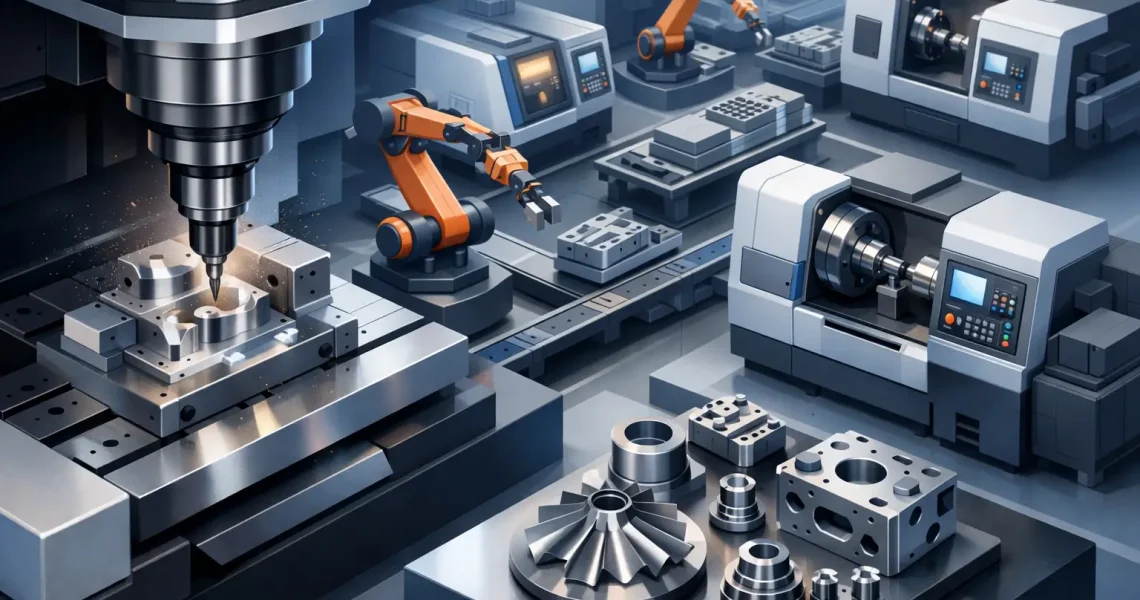
A part can meet the print and still fail on the floor. Holes are in the right place, tolerances look acceptable, and yet assembly drags, fit-up varies, or downstream performance becomes unpredictable. That is why precision CNC machining services are not just about making parts to dimension. For industrial buyers, they are about producing repeatable, application-ready components that hold up under real production conditions.
For engineers, project managers, and procurement teams, the real question is not whether a supplier owns CNC equipment. It is whether that supplier can control variation, understand function, and support the full manufacturing path from prototype through production. The difference shows up in scrap rates, schedule stability, inspection outcomes, and how many separate vendors you need to manage.
What precision CNC machining services should actually deliver
At a practical level, precision CNC machining services cover the controlled removal of material to create parts with tight tolerances, consistent geometry, and reliable finishes. That includes milling, turning, EDM, wire cutting, and secondary operations required to bring a component to specification.
But for most industrial applications, machining is only one part of the job. A bracket may need machined features after laser cutting and forming. A tooling component may require EDM after milling. A production assembly may depend on accurate machined interfaces before welding or final integration. When those processes are split across multiple suppliers, risk increases. Tolerance stack-up becomes harder to manage, timelines stretch, and accountability gets blurred.
A capable machining partner should reduce that complexity. The strongest providers do not treat each process in isolation. They look at the part, the assembly, the material, and the end-use environment, then choose a manufacturing route that balances precision, lead time, and cost.
Why buyers look beyond machine count
It is easy to be impressed by a long equipment list. Machines matter, but they are only part of the equation. What matters more is how that capacity is applied.
Programming quality has a direct effect on consistency. Fixturing affects repeatability. Material knowledge influences tool life, cycle time, and final surface condition. Inspection discipline determines whether a supplier catches variation early or ships problems downstream. In short, precision is built through process control, not marketing claims.
This is especially relevant in sectors such as semiconductor, pharmaceutical, aerospace, automation, and electrical manufacturing, where parts often serve a functional role inside a larger system. A high-tolerance component that is slightly inconsistent from batch to batch can create expensive disruptions later. Buyers in these sectors are rarely purchasing a standalone machined part. They are purchasing confidence in production performance.
Precision CNC machining services for prototypes and production
Prototype work and production work are related, but they are not the same challenge. A supplier that handles both well brings a meaningful advantage.
In prototyping, speed and technical responsiveness matter. Designs may still be evolving. Engineers may need feedback on machinability, tolerance realism, or alternate materials. The best machining partners engage early, identify potential issues before cutting begins, and help refine the part for manufacturability without compromising critical performance.
In production, the priority shifts toward repeatability, documentation, inspection consistency, and planning capacity. A part that was manageable as a one-off can become problematic when it needs to run at volume. Features that required manual intervention during prototyping may need better fixturing or process refinement before release to production.
This is where broad in-house capability becomes valuable. A supplier that can support both early-stage development and scaled manufacturing creates continuity. Knowledge from the prototype phase carries forward. Setup methods improve. Revision control becomes simpler. Communication shortens because the learning curve does not restart with a new vendor.
Material choice changes the machining strategy
Precision machining is never just geometry. Material selection shapes the process from the first setup to final inspection.
Aluminum may support faster cycle times and efficient prototyping, but some grades require careful attention to surface finish and burr control. Stainless steel offers strength and corrosion resistance, yet it can be slower to machine and more demanding on tooling. Tool steels and hardened materials raise the bar further, often requiring EDM or wire cutting to achieve the required detail and accuracy. Copper, brass, and specialty alloys introduce their own challenges in chip control, heat generation, and dimensional stability.
For buyers, the key point is this: the supplier should understand how the material interacts with the design intent. Tight tolerances on a stable geometry are one thing. Tight tolerances across thin walls, long spans, or heat-sensitive materials are another. The right machining partner will flag those realities early rather than treating every print as equally straightforward.
Where integrated fabrication creates a real advantage
Many industrial parts do not begin and end at the CNC machine. They may require laser cutting, turret punching, tube bending, rolling, welding, marking, or assembly before they are ready for use. Managing those steps across separate vendors adds handling, transport, communication delays, and more opportunities for dimensional drift.
An integrated manufacturing partner can simplify that chain. If a part moves from machining to fabrication to welding to assembly within one operation, process coordination improves. Teams can resolve tolerance interactions faster. Inspection points can be aligned to the final use case rather than limited to a single operation. Lead times often improve because production does not stall between subcontractors.
For OEMs and system integrators, that model also reduces administrative burden. Fewer purchase orders, fewer handoffs, and fewer vendor meetings mean more time focused on engineering and delivery.
This is one reason companies such as LUX METAL position machining within a larger turnkey fabrication framework. For customers with mixed-process components or complete assemblies, that structure can be more efficient than sourcing each operation separately.
How to evaluate a machining partner realistically
Buyers often ask about tolerance capability first, and they should. But tolerance alone does not tell the full story.
Ask how the supplier manages part complexity. A simple turned shaft and a multi-operation fixture plate should not be treated as equivalent jobs. Review whether they can support secondary processes in-house. Check if they understand the industry standards and operating conditions tied to your application. Inspection methods, revision control, and communication discipline are just as important as spindle hours.
It is also worth asking where the part is likely to be difficult. A strong supplier will give a direct answer. They will identify features that create risk, dimensions that may need tighter control, or drawing details that can be optimized for production. That kind of response is usually a better sign of capability than promising that every job will be easy.
Cost deserves the same level of nuance. The lowest quote may reflect limited inspection, outsourced secondary work, or optimistic lead time assumptions. A higher quote can make sense if it reduces nonconformance, shortens procurement coordination, and stabilizes delivery across the life of the project. The right decision depends on the total manufacturing picture, not just the line-item price.
When tight tolerances are worth it and when they are not
Not every feature needs extreme precision. Over-tolerancing is common, especially when drawings are inherited across revisions or pulled from legacy programs. It can increase machining time, inspection effort, and cost without improving function.
A good machining partner should help distinguish critical features from non-critical ones. Mating surfaces, bearing fits, datum relationships, and alignment features may justify tighter control. Cosmetic edges, clearance dimensions, or non-functional surfaces may not. That conversation is valuable because it protects both performance and budget.
This is where engineering support becomes a practical asset. Precision is not simply the ability to hold the tightest number on the drawing. It is the ability to apply control where it matters most.
The operational value of getting machining right
Well-executed machining improves more than part quality. It supports smoother assembly, more predictable maintenance, cleaner validation, and stronger schedule performance. For procurement teams, it can also reduce the hidden cost of supplier management when machining is integrated with broader fabrication and production support.
That matters in high-mix, custom manufacturing environments where every delay has a ripple effect. A missed tolerance can stall installation. A variation in a fixture can affect multiple downstream parts. A supplier that understands those relationships becomes more than a source of machined components. They become part of the production strategy.
The best precision CNC machining services do not sell precision as a slogan. They deliver it through planning, equipment, process discipline, and the ability to support the full job, not just the cut metal. If your parts carry tight tolerances, complex geometries, or assembly-critical features, the right partner should make the project easier to execute, not harder to coordinate. That is where real manufacturing value starts.