
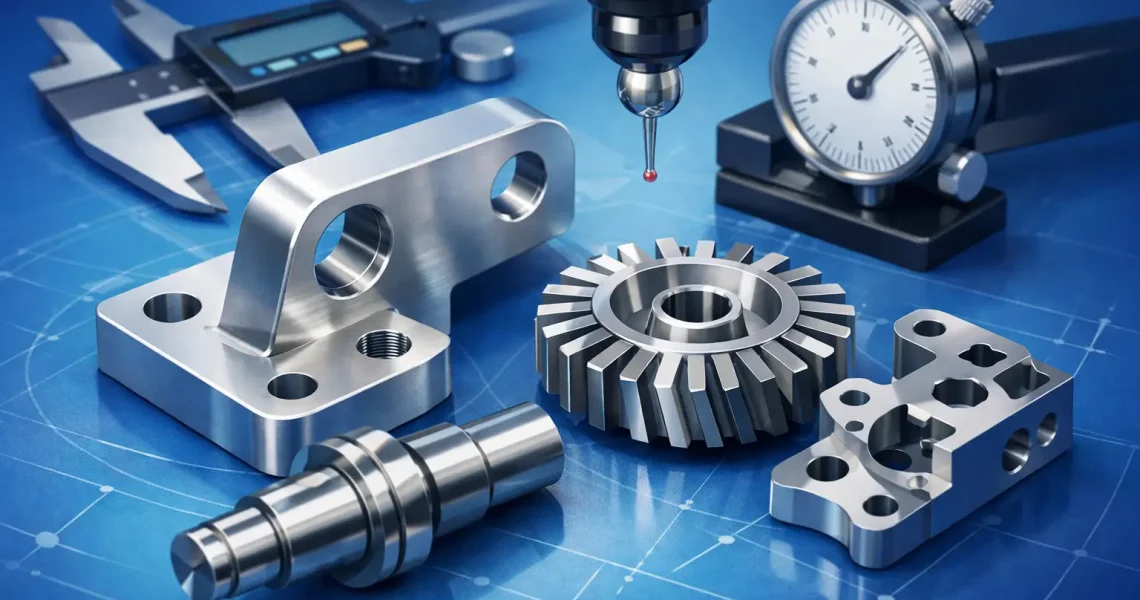
A few thousandths of an inch can decide whether an assembly runs smoothly, leaks under pressure, wears out early, or fails inspection. That is why high tolerance machined parts are not a niche requirement reserved for aerospace programs or advanced semiconductor tools. They are often the difference between a stable production line and recurring quality issues that consume time, labor, and margin.
For engineers, buyers, and operations teams, the real question is not whether tight tolerances sound impressive. It is whether they are necessary for the part, repeatable at scale, and supported by the right manufacturing controls. Precision has value when it serves function. Beyond that point, it adds cost without improving performance.
What high tolerance machined parts really mean
In practical terms, high tolerance machined parts are components produced within very narrow dimensional limits so they fit, align, seal, or move exactly as intended. The requirement may apply to diameter, flatness, perpendicularity, concentricity, surface finish, or a combination of geometric and dimensional features.
The critical point is that tolerance is not the same as accuracy in a general sense. A part can measure correctly on one feature and still fail in use if positional relationships between features are inconsistent. In many assemblies, function depends on the stack-up of multiple dimensions, not a single callout on a print.
That is why high-tolerance machining starts long before cutting metal. It begins with understanding the application, the mating parts, the operating environment, and the risks attached to variation. A shaft for a rotating assembly, a mold insert, a fixture, and a semiconductor component can all require tight control, but for very different reasons.
Where high tolerance machined parts are most critical
The closer a part is to a mission-critical function, the less room there is for variation. In aerospace and automation systems, tolerance affects motion control, structural integrity, and repeatability. In pharmaceutical and semiconductor equipment, it can affect cleanliness, sealing, alignment, and process consistency. In tooling, molds, dies, jigs, and fixtures, it directly influences the quality of every downstream part.
This is where many purchasing decisions become more technical than they first appear. A lower-cost quote may look acceptable on paper, but if the supplier cannot maintain consistency across batches, the total cost rises quickly through fit-up delays, rework, premature wear, and field failures.
High tolerance requirements also become more demanding when parts must integrate with fabricated assemblies. A precision-machined component may need to align with laser-cut features, formed sections, or welded structures. If these processes are managed separately by multiple vendors, dimensional variation tends to accumulate. A coordinated manufacturing approach reduces that risk.
Why tolerance control is harder than it looks
Producing one accurate part is not the same as producing fifty, five hundred, or five thousand accurate parts. Repeatability is where real manufacturing capability shows. Machine condition, tooling wear, material behavior, thermal expansion, fixturing, programming strategy, operator judgment, and inspection discipline all affect the result.
Material selection is a common source of variation. Aluminum, stainless steel, tool steel, copper alloys, and engineering plastics each respond differently during machining. Some materials move after stress is released. Others generate heat quickly or create burrs that complicate finishing and measurement. Tight tolerance work demands process planning that accounts for those behaviors rather than reacting to them after the fact.
Geometry adds another layer. A simple turned sleeve with a single critical bore is one thing. A multi-face machined part with deep pockets, thin walls, tapped holes, and demanding surface finish requirements is another. As geometry becomes more complex, the path to maintaining tolerance becomes narrower. Fixturing, workholding, cutting sequence, and in-process verification matter more with every additional feature.
The processes behind high tolerance precision parts
No single machine or method guarantees quality. High tolerance precision parts usually depend on a combination of equipment capability, engineering judgment, and disciplined inspection.
CNC milling and turning handle a wide range of close-tolerance features, especially when paired with stable setups and appropriate cutting tools. EDM and wire cutting become valuable when conventional machining reaches its limits, such as hardened materials, fine internal corners, or features that demand minimal cutting force. Grinding may be necessary when surface finish and exact size control go beyond what standard machining can reliably deliver.
Inspection is just as important as machining. CMM verification, calibrated handheld instruments, surface finish testing, and first-article inspection all help confirm that parts meet specification before they create problems in assembly. For tighter applications, measurement strategy must be built into the production process, not treated as a final checkpoint.
This is one reason full-service manufacturing partners are often better positioned for precision work. When machining, fabrication, welding, and assembly planning are coordinated under one roof, the team can manage tolerance relationships across the entire build rather than optimizing one process in isolation.
When tighter tolerance is worth the cost
There is always a trade-off. Tighter tolerance increases setup time, inspection effort, machining time, scrap risk, and sometimes finishing requirements. If a dimension does not affect function, forcing an unnecessarily tight tolerance can slow production and inflate cost without adding value.
The better approach is to apply precision where it matters most. Critical bores, sealing faces, datum features, alignment surfaces, and interfaces with purchased components typically deserve closer control. Non-critical cosmetic or clearance features often do not. Engineers who define this clearly help suppliers build an efficient process around actual functional need.
Buyers and project managers should ask a simple question early: what happens if this feature drifts? If the answer is leakage, binding, vibration, inaccurate positioning, or assembly failure, then tolerance deserves serious attention. If the answer is little to no functional impact, the specification may be tightened beyond reason.
How to evaluate a supplier for high tolerance machined parts
Capability claims are easy to make. What matters is whether a supplier can support precision parts consistently, communicate technical risk early, and scale from prototype to production without losing control.
A strong supplier should be able to review drawings with a manufacturing lens, identify tolerance concerns, recommend process adjustments, and explain how the part will be inspected. They should also understand adjacent processes if the machined part will connect to fabricated structures, welded assemblies, or secondary finishing operations.
Equipment breadth matters, but so does process discipline. A shop with CNC milling, turning, EDM, wire cutting, laser marking, and supporting fabrication capability can solve more complex part requirements without handing work off to outside vendors. That reduces lead time friction and improves dimensional accountability.
Responsiveness also matters more than many teams expect. Precision programs rarely move in a straight line. Design revisions, qualification requirements, and schedule pressure are common. A dependable manufacturing partner should be able to support design-for-manufacturing conversations, prototype adjustments, and controlled production release with minimal delay.
For industrial customers managing demanding applications, this is often where a company like LUX METAL brings value. The advantage is not only in machining equipment, but in the ability to align precision engineering, fabrication, assembly, and production planning around the final application.
Common problems that precision machining should prevent
When high tolerance work is done well, the result is not just a part that measures correctly. It is a part that makes the next step easier. Assemblies fit with less adjustment. Tooling lasts longer. Maintenance intervals become more predictable. Quality checks stop finding the same issue repeatedly.
When it is done poorly, the symptoms usually show up downstream. Operators shim components to make them fit. Assemblers force alignment. Bearings wear faster than expected. Seals fail. Fixtures introduce error into production. Procurement teams spend more time sorting rejected lots and expediting replacements.
These are not isolated quality events. They are process costs. That is why high tolerance machining should be treated as a production strategy, not just a print requirement.
What good precision support looks like early in a project
The best results usually come from early supplier involvement. If a machining partner reviews the drawing before release, they can often spot features that are difficult to inspect, overconstrained dimensions, or tolerance stacks that create avoidable cost. Small adjustments at this stage can improve manufacturability without changing function.
That kind of input is especially useful for custom equipment, molds, dies, jigs, fixtures, and mixed-process assemblies. These parts often combine tight tolerances with practical production constraints. A supplier that understands both engineering intent and shop-floor execution can help protect quality while keeping schedules realistic.
High tolerance machined parts are not about chasing perfection on every surface. They are about controlling the dimensions that matter, with the process discipline to repeat that performance when the project moves from one part to many. When precision is applied with purpose, it improves product reliability, simplifies assembly, and gives your operation fewer surprises to manage later.