
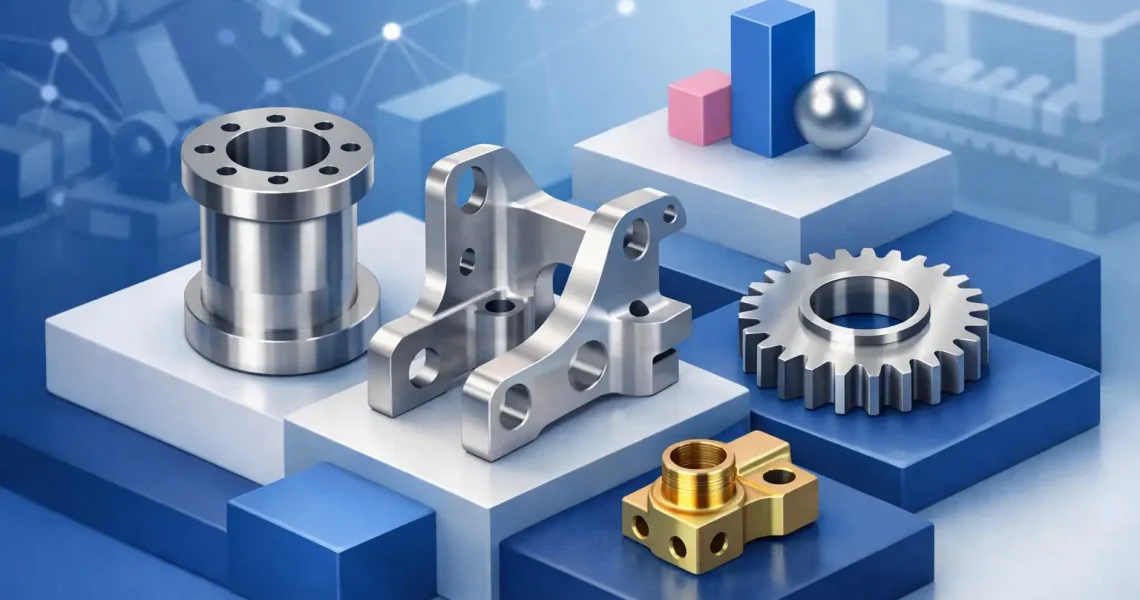
A late drawing revision can change everything. One hole shift, one tolerance stack issue, one material substitution, and an OEM program that looked straightforward starts affecting lead times, assembly fit, inspection, and cost. That is why precision metal parts for OEMs are not simply a purchasing category. They are a production-critical input that influences performance across the full build.
OEM teams usually feel the impact in practical terms. Engineering wants a part that matches design intent without repeated corrections. Procurement wants dependable output and fewer vendor handoffs. Operations wants consistency from first article through production release. When those priorities are handled by a supplier with broad in-house capability, projects move faster and with less friction.
What OEMs actually need from precision metal parts
For most OEMs, precision is only one part of the requirement. A part can hit a dimension on paper and still create problems if surface finish is inconsistent, if edge quality affects downstream assembly, or if the supplier cannot maintain repeatability across batches. In industrial and regulated sectors, the part also has to perform in the context of the final system.
That is why high-tolerance components are usually evaluated on a wider set of criteria. Material behavior, process stability, inspection discipline, and assembly compatibility matter just as much as nominal dimensions. A machined bracket, formed enclosure, fixture, or welded subassembly has to fit into the customer’s production environment without creating extra rework.
This is especially true in sectors such as semiconductor, pharmaceutical, aerospace, automation, electrical, and construction. These environments place different demands on the same supplier. One program may prioritize cosmetic finish and tight positional tolerance. Another may require structural strength, controlled welding distortion, or accurate integration with purchased components. The right manufacturing partner understands that precision is application-specific.
Precision metal parts for OEMs depend on process fit
No single process is right for every part. The best outcome usually comes from matching geometry, tolerance, material, and volume to the correct manufacturing route. That sounds obvious, but it is where many delays begin.
A part designed for CNC machining may be more efficiently produced through a combination of laser cutting, bending, and secondary machining. A fabricated assembly may benefit from fewer welded joints if the forming strategy is revised early. A toolmaker may need EDM or wire cutting because traditional machining cannot hold the required detail without compromising accuracy. These decisions affect both cost and manufacturability.
For OEMs, this creates a strong case for supplier consolidation around a capable fabrication partner. When laser cutting, CNC turret punching, tube bending, rolling, milling, turning, wire cutting, EDM, welding, assembly, and marking are managed under one roof, the production path can be engineered as a complete system rather than passed between disconnected vendors.
That matters in prototype work, but it matters even more in scaled production. Every transfer between suppliers introduces risk – dimensional drift, communication gaps, scheduling conflicts, and unclear responsibility when a part fails inspection or does not fit during assembly.
Why in-house capability changes outcomes
In-house capability does more than shorten a route sheet. It gives OEMs better control over revision handling, process planning, and quality accountability. If a customer updates a drawing, an integrated supplier can assess the effect on machining time, forming sequence, weld fixturing, and inspection requirements without waiting on multiple outside quotes.
This also improves speed during new product introduction. First articles often expose issues that are not visible in CAD, especially around hardware access, stack-up, and installation sequence. A supplier with machining, fabrication, and assembly knowledge can recommend design adjustments that protect function while making production more stable.
The trade-off is that broad capability only adds value if it is well managed. OEM buyers should not assume that a long equipment list guarantees execution. What matters is whether the supplier can translate capability into a controlled manufacturing plan with clear ownership from prototype to release.
From prototype to production without losing control
One of the common failure points in OEM sourcing is the gap between sample success and production repeatability. A prototype might be built with exceptional attention from senior technicians, only for production to struggle because setup discipline, fixturing, or inspection planning was never fully established.
Precision metal parts for OEMs need a handoff model that preserves what worked in development while preparing for production scale. That includes documented process parameters, material control, revision management, inspection checkpoints, and realistic cycle time assumptions. If any of those pieces are weak, the supplier may still produce acceptable parts, but not consistently or economically.
This is where turnkey manufacturing support has a practical advantage. When design review, fabrication, machining, welding, assembly, and commissioning are part of the same service model, the supplier can identify scale issues earlier. A bend sequence that works for ten pieces may not work for a thousand. A machining strategy that holds tolerance on one setup may become inefficient in a repeat program. Early visibility helps avoid expensive corrections later.
Tolerance is not the only quality metric
OEM teams often start with dimensional requirements because they are measurable and easy to specify. But quality in metal components goes further. Flatness after cutting, burr control, weld appearance, thread quality, heat impact, finish uniformity, and assembly alignment all affect how a part behaves downstream.
In some applications, the strictest feature on the drawing may not be the feature most likely to cause problems. A loose cosmetic panel gap can trigger customer complaints even if every critical dimension passes. A slight distortion in a welded frame can complicate final installation more than a minor non-critical deviation elsewhere. Experienced suppliers know where the real risks tend to be and build inspection around them.
How OEM buyers should evaluate a precision manufacturing partner
The strongest supplier conversations are specific. Instead of asking only whether a vendor can hold a tolerance, OEMs should ask how that tolerance will be achieved, verified, and maintained through volume changes. The answer reveals more than a generic capability statement.
A credible partner should be able to discuss process selection, inspection method, likely risk areas, and where cost pressure may conflict with design intent. In some cases, tighter tolerances are necessary. In others, they are inherited from a legacy drawing and add machining time without improving performance. Good manufacturing support is not about saying yes to every specification. It is about identifying what drives function and what can be optimized.
Buyers should also look at range. A supplier that can support molds, dies, jigs, fixtures, precision parts, and fabricated assemblies is often better positioned to support an OEM over time because the relationship is not limited to a single part family. As programs evolve, the need often expands from standalone components to integrated production support.
LUX METAL operates well in this space because the value is not tied to one machine or one department. It comes from combining sheet metal fabrication, CNC machining, welding, precision engineering, and assembly into a practical production solution for customer-specific requirements.
Where OEM programs gain the most value
The greatest value usually appears where complexity and accountability intersect. If an OEM is managing multiple fabricated and machined components that must fit together in a final assembly, a full-service partner can remove significant coordination burden. The gain is not just fewer purchase orders. It is faster technical response, better issue containment, and clearer ownership when something changes.
This is particularly useful in custom equipment, automation systems, industrial enclosures, support structures, machine frames, fixtures, and precision subassemblies. These are applications where tolerance, fabrication sequence, and assembly logic affect one another. Treating them as isolated jobs often leads to avoidable delays.
There are still cases where a single-process specialist makes sense, especially for very high-volume commodity parts or highly niche geometries. But for OEMs balancing complexity, speed, and reliability, an integrated partner often delivers better long-term control.
The practical question is not whether a supplier can make a part. It is whether that supplier can support the part as your program changes, volumes increase, revisions occur, and assembly expectations become more demanding. That is the standard precision work should meet.
When OEMs choose a manufacturing partner with the right process depth, production discipline, and application understanding, precision stops being a claim and starts showing up where it counts – in fit, repeatability, throughput, and fewer surprises on the floor. The best time to solve those issues is before the next revision forces the question.