
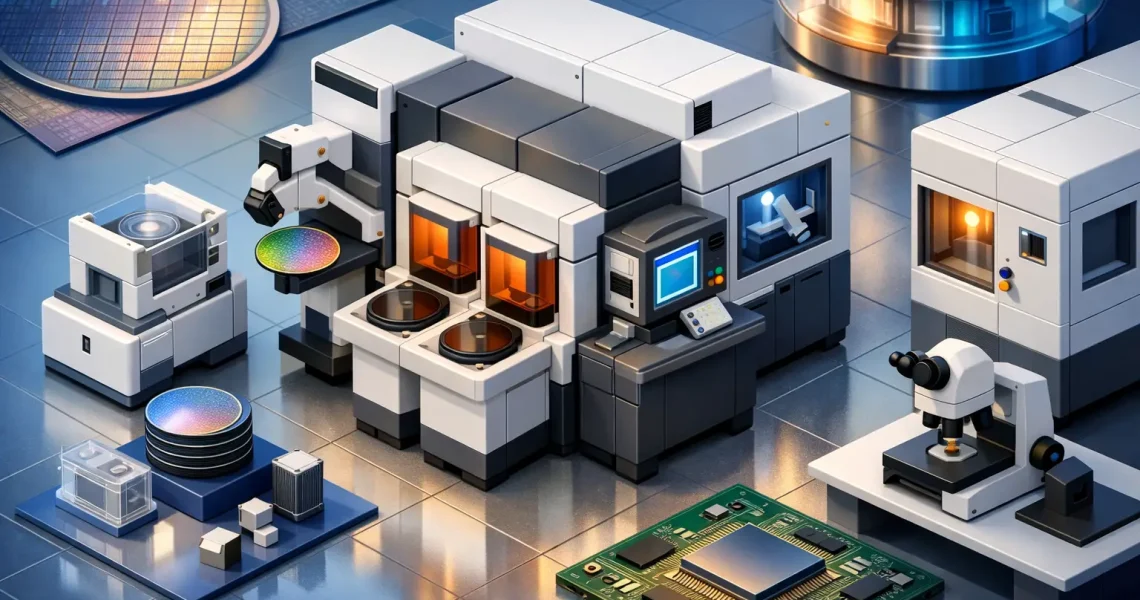
A chamber frame that is off by a fraction, a bracket that traps particles, or a weldment that shifts under thermal load can slow an entire semiconductor line. That is why semiconductor equipment fabrication is less about making metal parts and more about controlling risk across every stage of build, fit, and final performance.
For OEMs, integrators, and production teams, the challenge is rarely a single component. It is the interaction between precision-machined parts, formed sheet metal, welded structures, cable routing, access panels, mounting interfaces, and final assembly requirements. In semiconductor environments, small fabrication errors can become larger system problems once the equipment is installed, validated, and pushed into production.
What semiconductor equipment fabrication really requires
Semiconductor tools place unusual demands on fabrication partners because the hardware must satisfy both mechanical and process constraints. A support frame may need structural rigidity, but it also has to align with precision stages, panels, enclosures, utility routing, and service access. A cover set may appear simple, yet edge quality, flatness, hole position, and surface finish can all affect assembly speed and contamination control.
This is where general metal fabrication experience is useful, but not sufficient on its own. Semiconductor equipment fabrication usually involves tight dimensional tolerances, repeatable forming, controlled welding distortion, accurate machined interfaces, and consistency across low-volume prototypes as well as ongoing production batches. In many cases, the fabricated part is only one piece of a larger assembly, so tolerance stack-up matters just as much as the tolerance on the drawing.
Material selection adds another layer. Stainless steel, aluminum, and specialty metals each bring trade-offs in corrosion resistance, machinability, weight, thermal behavior, and finish quality. The right answer depends on the tool environment, the function of the part, and how the assembly will be cleaned, handled, and maintained over time.
Why process integration matters more than price alone
Procurement teams often compare quotes line by line, but semiconductor projects tend to expose the hidden cost of fragmented sourcing. When laser cutting, CNC machining, forming, welding, finishing, and assembly are split across multiple vendors, coordination becomes the real production bottleneck. Tolerance issues are harder to trace, revision control gets slower, and lead times stretch when one supplier is waiting on another.
An integrated fabrication partner reduces that friction. If the same team can review the drawing, cut the material, machine critical features, form panels, weld assemblies, and manage sub-assembly fit-up, problems are identified earlier and solved faster. That matters when equipment programs are moving from prototype to pilot build, or when an installed base needs spare parts with exact interchangeability.
The advantage is not only administrative. In-house process control improves dimensional consistency because the fabricator understands how one operation affects the next. A machined datum can be planned around a formed profile. A weld sequence can be adjusted to limit distortion before final machining. Assembly can be considered before the first sheet is cut, not after parts arrive and do not line up.
Core capabilities behind reliable semiconductor equipment fabrication
For semiconductor equipment, capability breadth is often a practical requirement rather than a marketing claim. A supplier may need to produce precision sheet metal panels, machine high-tolerance blocks and plates, create support structures, build jigs and fixtures, and complete mechanical assemblies under one roof.
Laser cutting and CNC turret punching support accurate blank preparation for enclosures, guards, brackets, and access panels. CNC bending and rolling help maintain repeatable forms across panels and structural elements. Milling, turning, EDM, and wire cutting become critical where mating surfaces, ports, slots, and custom features must meet strict tolerances. Welding capability matters for frames, stands, skids, and welded fabrications that still need dimensional stability after joining.
The detail work is just as important as the machine list. Deburring, edge condition, hole quality, marking, and finish consistency all affect final equipment build quality. A part that meets nominal dimensions but arrives with poor edge control or assembly interference still creates delays. Buyers in this sector are usually looking for a supplier that understands that manufacturability and install readiness are part of the same job.
Design for fabrication in semiconductor applications
Many cost and schedule issues start before production, during drawing release and design handoff. Semiconductor equipment fabrication works best when the fabricator is engaged early enough to review tolerances, material assumptions, bend feasibility, weld access, and assembly sequence.
Not every dimension needs the same level of control. Critical mounting faces, precision hole patterns, and alignment features may justify tighter tolerances, while non-functional cosmetic dimensions may allow more manufacturing flexibility. If everything is specified at maximum precision, cost rises without improving tool performance. If too much is relaxed, fit and function suffer. Good fabrication feedback helps engineering teams place precision where it matters.
The same principle applies to assembly access. Covers, doors, brackets, and subframes need to support maintenance as well as manufacturing. A design can look efficient in CAD and still be difficult to weld, inspect, or service once built. Practical review of clearances, fastener reach, panel removal, and utility routing saves time later in the program.
Cleanliness, finish, and handling are part of the job
Semiconductor manufacturing environments are unforgiving when it comes to contamination. While not every fabricated part sits directly in the most sensitive process zone, many assemblies still require controlled finishing, careful handling, and packaging discipline.
Surface condition matters because rough edges, weld spatter, trapped debris, and inconsistent finishes can create avoidable risk. The right finish depends on the application. Some parts prioritize corrosion resistance and cleanability, while others need cosmetic consistency for external panels and operator-facing assemblies. There is no single finish standard that fits every tool, which is why application context matters.
Handling and packaging should also match the value of the part and the sensitivity of the assembly. Precision-machined surfaces, cosmetic panels, and assembled weldments can all be damaged in transit if protection is treated as an afterthought. For semiconductor customers, quality is not limited to what leaves the machine. It includes how the part arrives, how quickly it can be inspected, and how reliably it drops into the build.
Prototype to production without losing control
Semiconductor programs often move in stages. Early builds may involve frequent revisions, low volumes, and aggressive timelines. Once the design stabilizes, the same parts may shift into repeat production with stricter delivery expectations. A fabrication partner needs to support both phases without introducing variation that forces requalification.
This is where production readiness becomes a differentiator. Prototype work requires responsiveness and technical communication. Production work requires repeatability, documentation discipline, and scheduling control. The supplier that can do one but not the other can still create a handoff problem later.
At LUX METAL, that transition is treated as part of turnkey metal fabrication rather than a separate challenge. Broad in-house capability helps maintain continuity from early custom builds to ongoing manufacturing support, especially for high tolerance precision parts and assemblies used in specialized equipment.
How buyers should evaluate a fabrication partner
A capable semiconductor fabricator should be evaluated on more than machine capacity. Buyers should look at whether the supplier can interpret engineering intent, flag manufacturability issues early, hold required tolerances consistently, and manage assemblies rather than just individual parts.
Industry familiarity matters because semiconductor equipment has a different risk profile than general industrial hardware. Ask how the supplier handles revision changes, mixed-process parts, distortion control, finish requirements, and packaging for sensitive assemblies. Review whether they can support both custom one-off builds and repeat orders without losing dimensional consistency.
Speed is important, but speed without control usually creates more work downstream. The stronger partner is the one that can respond quickly while still protecting quality, documentation, and fit. That balance is what keeps equipment programs moving.
Semiconductor equipment fabrication rewards discipline. The right fabrication partner brings more than capacity to the table. They bring process control, cross-functional manufacturing knowledge, and the ability to turn demanding drawings into parts and assemblies that install correctly, perform reliably, and support production without added friction. When the application is critical, precision is not just a specification. It is the baseline for execution.