
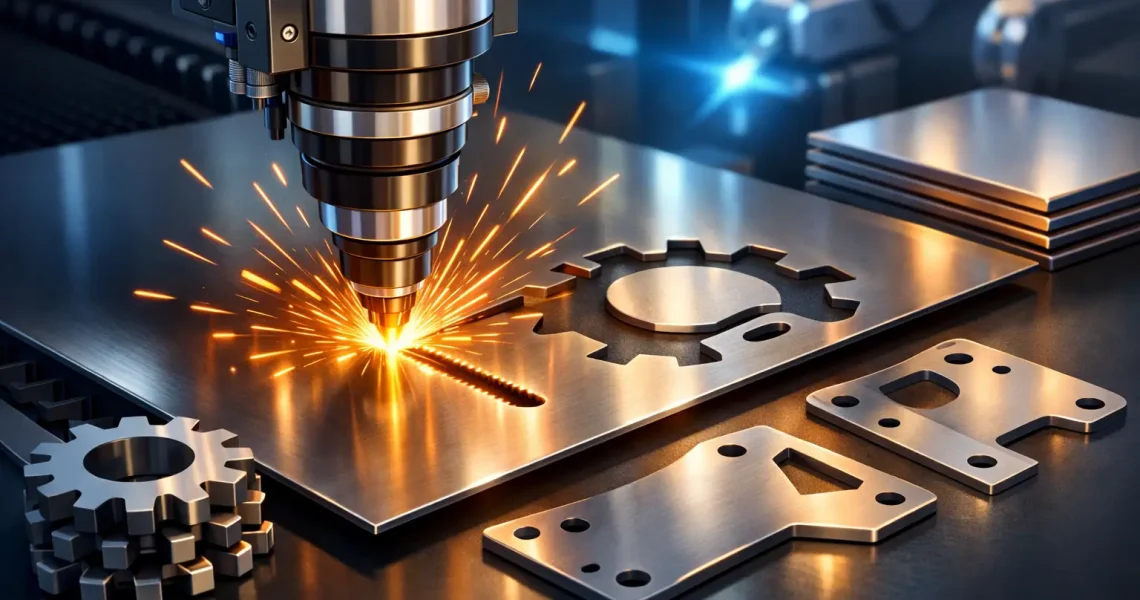
When a part drawing calls for tight tolerances, clean edges, and repeatable output, laser cutting services for metal usually move to the top of the sourcing list. That is not just because lasers are fast. It is because the process gives engineers, buyers, and production teams better control over part quality, material use, and downstream fabrication.
For industrial and commercial projects, that control matters. A bracket that fits without rework, a panel that enters forming with accurate hole placement, or a production run that holds consistency from first piece to last can affect lead times, assembly efficiency, and total project cost. Laser cutting is often the first operation, but its impact carries through the entire build.
Why laser cutting services for metal matter in production
Metal fabrication starts with cutting, but not every cutting method supports the same level of precision. Laser cutting uses a concentrated beam to cut sheet metal with high accuracy and minimal distortion when the process is properly matched to the material and thickness. That makes it well suited for parts with detailed contours, small features, tight hole patterns, and cosmetic requirements.
For OEMs, contractors, and system integrators, the advantage is practical. Accurate blanks reduce issues in bending, welding, and assembly. Clean cut quality can lower secondary finishing requirements. Reliable nesting can improve material utilization. If a project includes prototype iterations and then transitions into production, the same process can often support both stages without changing the manufacturing approach.
That said, laser cutting is not automatically the right answer for every job. Material type, gauge, feature density, edge expectations, and annual volume all affect whether laser cutting is the best fit or whether another process should be used alongside it.
What to expect from a capable laser cutting partner
A serious fabrication partner does more than load sheets and press start. The real value comes from how the job is engineered before the first cut and how well the cutting process connects to the rest of production.
Quoting accuracy is one sign of capability. A supplier that reviews drawings carefully, flags tolerance conflicts, and asks informed questions about application requirements is usually protecting the job from avoidable issues later. In B2B manufacturing, that matters more than a fast but shallow quote.
Machine capacity matters too. Different laser systems handle different material ranges, part sizes, and throughput demands. If your project involves stainless steel panels, mild steel structural parts, aluminum enclosures, or mixed-material production, your supplier should have the equipment and process knowledge to adjust cutting parameters accordingly.
Just as important is what happens after cutting. Many buyers are not looking for a standalone cutting vendor. They need a partner who can move the cut parts into CNC punching, forming, machining, welding, assembly, marking, or installation without handing the project to multiple shops. That reduces coordination risk and gives the customer a more predictable production path.
Materials, tolerances, and design realities
Laser cutting is widely used on stainless steel, carbon steel, aluminum, and other metals used in industrial fabrication. Each material behaves differently. Stainless can produce excellent edge quality but may require careful gas selection and parameter control. Aluminum reflects more energy and can present process challenges depending on thickness and grade. Mild steel is often efficient to cut, but scale, flatness, and downstream welding needs still affect setup decisions.
Tolerance expectations also need context. Buyers sometimes request very tight tolerances on every feature when only a few dimensions are critical to function. A strong fabrication partner will identify which dimensions must be held closely and which can follow standard fabrication tolerances. That keeps cost aligned with actual performance requirements.
Design for manufacturability is part of the discussion. Extremely small holes relative to material thickness, narrow webs, aggressive internal corners, and dense feature spacing can affect cut quality or production efficiency. In those cases, a quick design adjustment may improve yield without changing the part’s function. This is where engineering support adds value beyond basic cutting capacity.
Prototype work and production runs require different thinking
Prototype laser cutting often prioritizes speed and flexibility. The goal is to get parts into testing quickly so the design team can verify fit, form, and function. Production work adds another layer. Repeatability, fixture strategy, revision control, packaging, and inspection become more important as volumes grow.
A supplier that supports both prototype and production can help avoid the common problem of proving a design with one vendor and then requalifying the part with another. That continuity is especially useful in sectors where documentation, consistency, and schedule discipline are non-negotiable.
Where laser cutting fits in a full fabrication workflow
Laser cutting works best when it is treated as part of a connected manufacturing system. A cut blank is rarely the final product. It may go on to bending, rolling, machining, tapping, welding, surface finishing, or mechanical assembly. If those next steps are not considered early, the part may be technically cut correctly but still create trouble later on the floor.
For example, bend reliefs need to support forming. Hole placement may need to account for post-bend alignment. Weld prep and edge condition can affect fabrication time. Assembly features should match the real-world stack-up, not just the CAD model. This is why many industrial buyers prefer turnkey metal fabrication over a patchwork of specialized vendors.
For complex projects, one-source execution can simplify purchasing and improve accountability. The same team can review the drawing package, cut the material, form the parts, machine critical features, weld assemblies, and prepare the project for installation or commissioning. That model is often more efficient than managing separate suppliers at each step.
How industrial buyers should evaluate laser cutting services for metal
Price is part of the decision, but not the whole decision. A lower piece price can disappear quickly if the supplier struggles with quality consistency, revision control, or delivery performance. For production buyers, the better question is whether the supplier can support the full requirement with confidence.
Start with process fit. Can the supplier cut the required material and thickness range reliably? Can they handle the part size and geometry? Do they understand high-tolerance applications, or are they mainly set up for general commercial work?
Then look at operational depth. A partner with broad in-house capacity can often react faster when a schedule shifts or a design change is issued. That matters in industries such as semiconductor, pharmaceutical, aerospace, automation, electrical, and construction, where timelines and compliance expectations can tighten quickly.
Communication is another differentiator. Technical responsiveness is not a soft benefit in fabrication. If an engineer sends a revised drawing, a procurement team needs clear feedback on lead time, manufacturability, and cost impact. Delayed or vague responses create risk, especially when the parts feed larger assemblies or customer deadlines.
Common trade-offs buyers should understand
Faster lead times may limit options for secondary finishing or inspection reporting. Ultra-tight tolerances may increase cost without improving real performance. High cosmetic expectations may require more careful handling and packaging. These trade-offs are normal, and a good supplier will address them directly rather than promising everything at once.
Volume is another factor. Laser cutting is excellent for custom parts, short runs, and medium-volume production, but if annual demand becomes very high and the geometry is simple, alternative processes may deserve review. The right partner will recommend the process mix that supports the application, not just the machine they want to keep busy.
The value of working with a full-service manufacturing partner
When buyers source laser cutting as part of a larger fabrication strategy, they usually want fewer handoffs, tighter quality control, and better schedule visibility. That is where a full-service manufacturing partner stands apart from a single-process shop.
LUX METAL supports this model by combining laser cutting with CNC machining, metal forming, welding, assembly, and precision engineering under one roof. For customers managing custom equipment, enclosures, structural fabrications, precision parts, or integrated assemblies, that breadth can reduce vendor overlap and improve project coordination.
The benefit is not just convenience. It is execution control. When engineering review, cutting, fabrication, and finishing operations are aligned, there is less room for mismatch between the drawing, the process, and the final build. That is especially valuable on jobs where accuracy and delivery performance carry operational consequences.
Selecting laser cutting services for metal should come down to more than who can cut a profile. The better choice is the partner who understands how that profile performs in the full manufacturing chain and can build the rest of the project around it with the same level of precision.