
A late design change, a tighter installation envelope, a tolerance stack-up that no longer works – this is where custom sheet metal fabrication services stop being a purchasing line item and become a project control strategy. For industrial and commercial teams, the right fabrication partner does more than cut and bend metal. It reduces coordination risk, supports engineering intent, and keeps production moving when complexity increases.
Standard components have their place, but many projects do not fail because a catalog part was unavailable. They fail because the available part does not fit the assembly, the finish is wrong for the environment, the tolerance is too loose for downstream integration, or the supplier can only manage one step of the process. When a component has to perform inside a larger system, customization is often the practical route, not the premium route.
What custom sheet metal fabrication services actually cover
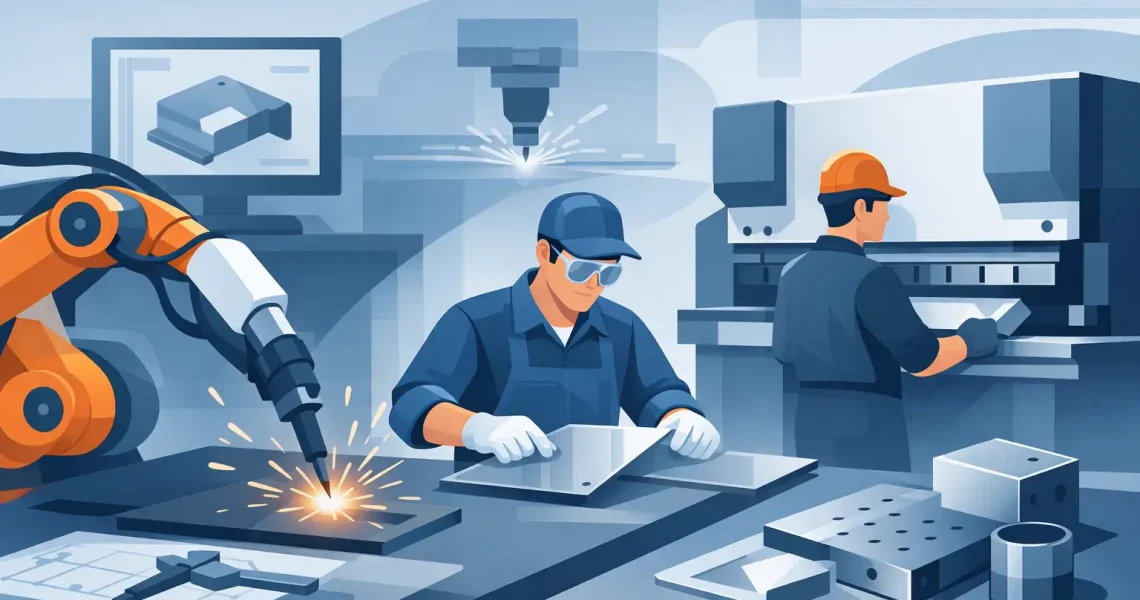
In industrial manufacturing, custom sheet metal fabrication services typically extend well beyond forming a flat sheet into a bracket or enclosure. The real value is in combining engineering review, material selection, laser cutting, turret punching, bending, rolling, welding, machining, marking, assembly, and in some cases installation or commissioning. That broader scope matters because most fabricated parts do not operate alone. They connect to frames, electronics, pneumatic systems, machine guards, panels, fixtures, or structural supports.
A supplier with only one or two process capabilities can produce a part, but not always the finished solution. That gap creates handoffs between vendors, more drawing interpretation, more scheduling pressure, and more opportunities for dimensional drift. By contrast, an integrated fabrication partner can control the build path from prototype through production, while maintaining traceability across operations.
This is especially relevant in sectors such as semiconductor, pharmaceutical, aerospace, automation, electrical, and construction, where performance requirements are often tied to tight tolerances, surface condition, cleanliness, repeatability, or assembly fit. In those environments, fabrication is not judged only by whether the part is made. It is judged by whether the part installs correctly, functions reliably, and arrives on schedule.
Why industrial buyers choose custom over off-the-shelf
The decision to source a custom fabricated component usually comes down to fit, function, or risk. Sometimes all three are involved. A machine builder may need a stainless enclosure with precise cutouts, formed features, and mounting points that align with internal hardware. A contractor may need structural metalwork adapted to field conditions that changed after the original design package. An OEM may need repeatable high-tolerance parts that can move from prototype into scheduled production without changing suppliers midway.
Off-the-shelf options can appear faster at first, but they often shift effort elsewhere. Teams end up modifying parts in-house, redesigning surrounding assemblies, accepting compromised performance, or managing several specialized vendors to get one finished result. That hidden coordination cost is significant. Engineering time, procurement overhead, and production delays usually exceed the apparent savings of a standard part.
Custom fabrication gives project teams control where it matters most. Hole patterns match real mounting conditions. Bend allowances reflect the material and geometry being used. Weldments are built with the final application in mind. Machined features can be added after forming when tolerances demand it. Those details are not extras. They are what make a fabricated component usable in the field or on the production floor.
What to look for in a custom sheet metal fabrication partner
Capability breadth is the first filter, but it should not be the only one. A supplier may have laser cutting and press brake capacity, yet still struggle with assemblies that require precision machining, welding discipline, tube bending, or secondary finishing. Industrial buyers benefit most from a fabrication partner that can support multiple process paths under one roof and recommend the most efficient route based on the application, quantity, and tolerance requirements.
Engineering responsiveness matters just as much as machinery. Many fabrication issues start upstream, when a part is technically manufacturable but inefficient to produce, difficult to inspect, or vulnerable to distortion during welding. A strong partner will identify these risks early, suggest practical revisions, and align the design with production reality. That does not mean forcing every part into a standard template. It means preserving function while improving manufacturability and repeatability.
Production scalability is another critical factor. Some suppliers are strong at prototypes but lose consistency in volume. Others are optimized for production but too rigid during development. The better model is a shop that can support both phases, using the prototype stage to validate geometry, assembly fit, and process flow before moving into repeatable manufacturing.
Quality control should also be evaluated in practical terms. For industrial and commercial buyers, quality is not a marketing phrase. It is dimensional accuracy, material compliance, weld integrity, repeatability between batches, and documentation that supports the customer’s own quality requirements. The tighter the application, the more this matters.
How process integration improves lead time and quality
The biggest advantage of turnkey fabrication is not convenience alone. It is control. When laser cutting, forming, machining, welding, and assembly are managed in one production environment, the supplier can coordinate tolerances across operations instead of leaving each vendor to interpret only their own step.
That coordination reduces common failure points. A formed part that needs post-machining can be sequenced correctly. A welded assembly can be built with fixturing that reflects downstream machining or installation requirements. Laser-marked identification can be added at the right stage to preserve visibility and traceability. These are small decisions individually, but together they determine whether a project moves smoothly or accumulates rework.
Lead time benefits are real, although they depend on the complexity of the job. Integrated service does not automatically mean every project is fast. If a build includes intricate tolerances, multiple material types, or extensive assembly work, it will still require disciplined scheduling. What integration does provide is fewer external queues, fewer shipping delays between processes, and faster problem resolution when a revision is needed.
For buyers managing deadlines across multiple stakeholders, that reduction in friction is often more valuable than a nominal piece-price advantage elsewhere.
Where custom sheet metal fabrication services create the most value
Custom fabrication is most valuable when the part is tied to system performance, field fit, or production continuity. Enclosures, machine frames, support structures, brackets, access panels, cabinets, housings, guards, trays, and integrated assemblies all benefit from application-specific design and production control. The value increases further when the fabricated part interfaces with machined components, wiring, pneumatics, controls, or installation constraints.
High-mix, low-volume environments are a common fit, especially where design variation is frequent and standardization is limited. At the same time, custom does not mean one-off only. Many buyers need a partner that can start with a prototype or pilot run and then scale into ongoing production once the design is locked. That transition is often where supplier capability is tested.
For regulated or precision-driven sectors, customization also supports compliance and process reliability. Material selection, finish requirements, clean welds, precise cutouts, and repeatable dimensions are easier to maintain when the fabrication route is planned around the actual application instead of adapted from a generic part.
Common trade-offs buyers should weigh
Customization brings clear advantages, but it is not exempt from trade-offs. More tailored parts can require more up-front engineering review, especially if the design is still evolving. Complex assemblies may also have longer qualification cycles because fit, function, and tolerance interactions must be proven before release.
Cost depends heavily on geometry, material, process mix, and order volume. A highly optimized custom part can reduce total system cost, while an overengineered one can do the opposite. That is why design-for-manufacturing input is so important early in the process. The goal is not simply to make the part as drawn. It is to produce the required outcome with the least avoidable waste in time, material, and labor.
Vendor consolidation is another area where trade-offs need honest review. Moving more scope to one supplier can improve accountability and scheduling, but only if that supplier truly has the in-house depth to manage the work at the required standard. Breadth without execution discipline does not solve much.
A better way to source complex fabricated parts
For procurement teams and engineers, the best sourcing outcome usually comes from early technical engagement. Share the operating environment, tolerance priorities, assembly interfaces, and expected volumes at the quoting stage. Flag the dimensions that are truly critical and the ones that allow flexibility. Clarify whether the need is prototype validation, bridge production, or long-term supply. Those details help a fabrication partner build the right process plan instead of pricing only the drawing.
This is where a full-service manufacturer can create measurable value. Companies such as LUX METAL are built around that model – combining fabrication, machining, welding, assembly, and production support so customers can move from concept to finished hardware with fewer handoffs and better process control.
When the part is critical, custom work should not feel custom in the chaotic sense. It should feel engineered, repeatable, and ready for production. That is the standard worth looking for, especially when the next delay, revision, or fit issue will cost more than the component itself.