
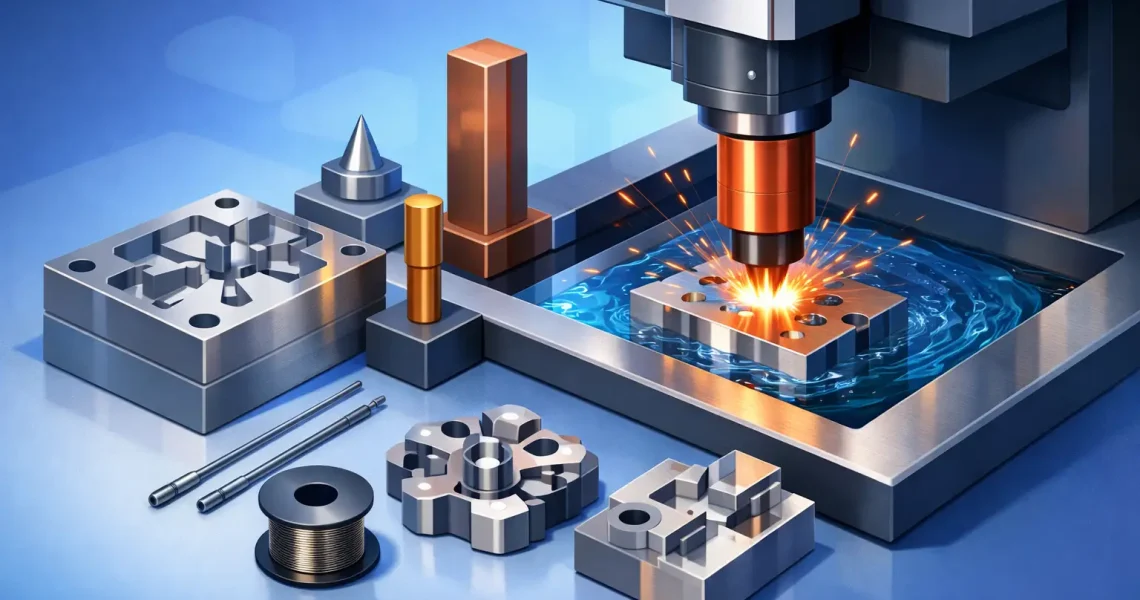
When a punch, die insert, mold component, or fixture feature is too hard, too delicate, or too tight for conventional cutting, EDM machining services for tooling stop being a backup option and become the right process. For tooling programs where burrs, tool pressure, or cutter access create risk, EDM gives engineers and buyers a controlled way to produce complex geometry without compromising material integrity.
That matters in real production environments. Tooling is expected to locate, cut, form, hold, or repeat with very little room for variation. If the tool is off, the downstream cost shows up fast in scrap, setup delays, short tool life, and line interruptions. EDM is valuable because it addresses some of the most stubborn tooling challenges directly, especially in hardened materials and high-tolerance features.
Where EDM machining services for tooling fit best
EDM, or electrical discharge machining, removes material with controlled electrical sparks rather than a rotating cutting tool. In tooling work, that changes what is practical. Hard tool steels, carbide, and intricate profiles can be machined after heat treatment, which helps preserve dimensional stability and reduces the distortion risk that can come with rough machining first and hardening later.
For dies and molds, EDM is often the process that makes critical details possible. Sharp internal corners, narrow slots, blind cavities, fine ribs, and intricate punch shapes are common examples. Wire EDM is especially effective for cutting precise profiles through conductive material, while sinker EDM is used for cavity forms and complex internal features that cannot be reached efficiently with standard milling.
This is why EDM is frequently specified for progressive die components, stamping tools, extrusion dies, mold inserts, jigs, fixtures, gauges, and replacement wear parts. The process is not universal, and it should not be treated that way, but in the right application it solves geometry and hardness limitations that conventional machining cannot address cleanly.
Why tooling buyers specify EDM
The first reason is tolerance control. Tooling components often need exact mating relationships, predictable clearances, and repeatable geometry across multiple parts. EDM supports this by minimizing cutting forces. There is no direct tool pressure pushing against the workpiece, which helps protect thin walls, small features, and delicate sections from deflection during machining.
The second reason is material condition. Many tooling parts are made from hardened steels because wear resistance and dimensional stability matter more than easy machinability. Machining these materials conventionally can be slow, expensive, or limited by cutter wear. EDM works well in hardened conductive materials, making it a practical route for final geometry in demanding tools.
The third reason is feature quality. A tooling component may require a profile that is not just dimensionally accurate, but also consistent edge to edge and from lot to lot. That is particularly important for interchangeable inserts, replacement punch profiles, and fixture details that must fit existing assemblies without rework.
Still, EDM is not automatically the fastest or lowest-cost process for every tooling job. If a feature can be milled easily with standard tooling and the tolerance is moderate, conventional machining may be more economical. Good manufacturing planning is about using EDM where it adds value, not where it simply adds process time.
Wire EDM and sinker EDM in tooling applications
Wire EDM is commonly selected when the part needs a cut-through profile with high precision. Tooling examples include punches, die sections, stripper plates, inserts, shims, and profile gauges. Because the wire cuts along a programmed path, it can generate intricate contours with consistent accuracy. It is also well suited to small internal radii and features that would be difficult to produce with end mills due to cutter diameter limits.
Sinker EDM is different. It uses a shaped electrode to burn a cavity into the workpiece, which makes it suitable for blind pockets, detailed forms, and internal geometries in molds and dies. If a tooling component requires a deep cavity, textured geometry, or sharp internal detail that milling cannot reach effectively, sinker EDM is often the practical choice.
In many tooling programs, the best result comes from combining processes rather than relying on one. A component may be milled for general geometry, heat treated for hardness, ground for datum surfaces, and then finished with wire or sinker EDM on critical features. For buyers and engineers, this integrated approach usually produces better results than trying to force one process to do everything.
Material, finish, and tolerance considerations
Tooling performance depends on more than shape alone. Material selection, surface condition, and edge integrity all influence service life. EDM supports a wide range of conductive tooling materials, including hardened tool steels, stainless grades, and carbide, but the correct setup depends on the material and the application.
Surface finish is one area where expectations need to be matched to function. EDM can achieve fine finishes, but required finish levels affect cycle time. For a die cavity or mold insert, a finer finish may be necessary to support part release, reduce secondary polishing, or meet cosmetic requirements. For a fixture plate or a non-contact wear component, a less aggressive finish target may be more cost-effective without affecting performance.
Tolerance should be handled the same way. Tight tolerances are often necessary in tooling, but not every dimension carries the same importance. The smartest projects identify critical-to-function dimensions, mating surfaces, and wear interfaces early. That allows machining strategy, inspection planning, and cost to stay aligned with actual performance needs.
What to look for in an EDM tooling partner
For B2B buyers, EDM capability is not just about whether a supplier has the machine. The bigger question is whether they can support the full tooling requirement. That includes drawing review, material understanding, process selection, inspection discipline, and the ability to coordinate EDM with milling, turning, grinding, fabrication, or assembly if the job requires more than one operation.
This is where an in-house manufacturing environment matters. Tooling projects rarely move in a straight line. A prototype insert may need revision after a first trial. A fixture may require machining, welding, and final fit-up. A replacement component may need to match legacy dimensions while improving wear life. Working with a supplier that can manage these transitions internally reduces handoff risk and shortens response time.
Technical responsiveness also matters. Buyers and engineers need practical answers early. Can the feature be cut after hardening? Is the corner radius achievable? Will the cavity require an electrode strategy that affects lead time? Can the part be inspected against the drawing in-house? Clear answers at quoting and planning stage save time later.
At LUX METAL, EDM is part of a broader precision manufacturing capability that supports tooling, molds, dies, jigs, fixtures, and high-tolerance production parts. That matters for customers who want one manufacturing partner capable of handling complex metal work from prototype through production support.
Common tooling scenarios where EDM adds real value
One common case is a hardened die component that needs a profile change after heat treatment. Recutting conventionally may not be practical, but wire EDM can make the revision accurately without introducing heavy cutting forces. Another is a mold insert with narrow ribs or deep internal details that are difficult to machine and finish by milling alone.
EDM is also valuable for fixture and gauge components where repeatable fit is critical. If the fixture locates a part used in automation, semiconductor equipment, aerospace subassemblies, or pharmaceutical production systems, dimensional drift is not a minor issue. Precision in the tooling supports precision in the final assembly.
There is also the replacement-part scenario. Production tooling wears. Inserts chip. Punches break. Legacy drawings may be incomplete. A capable EDM supplier can often reverse-engineer critical geometry, reproduce precision features, and help restore uptime faster than a fragmented multi-vendor approach.
EDM machining services for tooling and production continuity
Tooling is a production asset, not an isolated part number. When a tool underperforms, the cost extends beyond the component itself. It affects press efficiency, inspection workload, product quality, maintenance frequency, and delivery schedules. EDM supports production continuity because it allows precise, repeatable manufacture of the features that define tooling performance.
The right application is the key. EDM is best used where hardness, detail, access, and tolerance make conventional methods less effective. When paired with sound engineering review and integrated machining support, it becomes a practical advantage for manufacturers that cannot afford inconsistency in their tools.
If your tooling program includes hardened materials, complex profiles, or critical replacement components, the best next step is usually a technical review of the drawing, function, and production context. The process choice should follow the requirement, and the requirement should always be tied back to how the tool performs on the floor.