
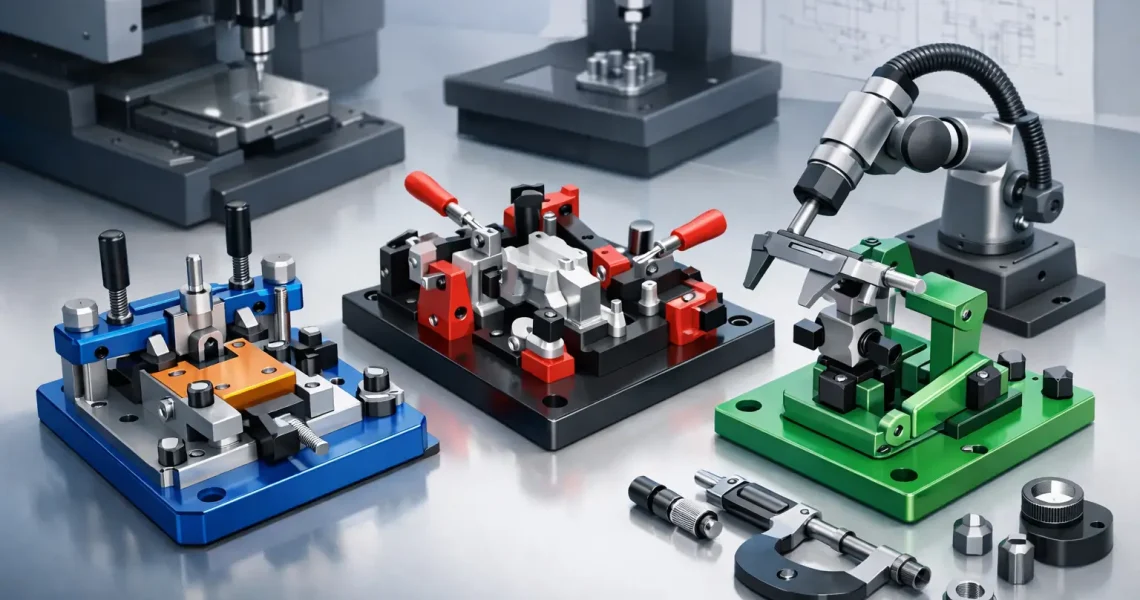
A production line rarely loses time because of one dramatic failure. More often, output slips through small positioning errors, inconsistent setups, and repeated operator adjustments. That is where custom jigs and fixtures manufacturing becomes a practical advantage. When tooling is engineered around the part, the process, and the production target, it reduces variation at the source and gives teams a more controlled path to repeatable results.
For OEMs, automation builders, contractors, and high-mix manufacturers, standard workholding is not always enough. Complex geometries, tight tolerances, and multi-step assembly requirements often call for purpose-built tooling. A well-designed jig or fixture supports precision, but just as importantly, it supports production speed, operator consistency, and smoother downstream quality control.
What custom jigs and fixtures manufacturing solves
Jigs and fixtures are often mentioned together, but they serve different roles. A jig guides a tool during an operation such as drilling or cutting. A fixture secures and locates the workpiece in the correct position. In both cases, the objective is the same – remove guesswork from production.
In real manufacturing environments, that objective affects more than dimensional accuracy. It influences cycle time, scrap rate, rework, training time, and even safety. If an operator needs to make frequent judgment calls during setup, the process carries more risk. If the part is always located the same way and clamped with the right force in the right sequence, the process becomes easier to control.
This is especially relevant in sectors such as semiconductor, pharmaceutical equipment, aerospace support components, electrical enclosures, and industrial automation. These applications often involve precision-machined parts, sheet metal assemblies, welded structures, or mixed-material subassemblies that cannot tolerate inconsistent handling.
Why standard tooling often falls short
Off-the-shelf clamps, vises, and generic workholding systems are useful, but they are designed for broad compatibility. That flexibility can become a limitation when a part has unusual surfaces, thin walls, cosmetic requirements, or multiple critical datums.
A custom fixture can be built around the exact geometry of the component and the realities of the process. That may mean controlling distortion in a welded assembly, protecting finished surfaces during handling, or presenting a part to a CNC machine in a way that reduces secondary setups. In assembly environments, it may mean ensuring alignment between several components before fastening, bonding, or inspection.
There is a trade-off, of course. Custom tooling requires engineering time, fabrication resources, and validation before release. For very low-volume work, a simple manual setup may be more economical. But once part complexity, repeat volume, or quality requirements increase, purpose-built jigs and fixtures often pay for themselves quickly through reduced labor, fewer errors, and more stable throughput.
The engineering behind reliable custom jigs and fixtures manufacturing
Effective tooling starts with understanding the part and the process together. A fixture that looks correct on a drawing can still underperform if it ignores cutter access, chip evacuation, weld sequence, ergonomic loading, or measurement requirements. Good tooling design is not isolated from production. It is developed around how the work will actually be done on the floor.
That usually begins with reviewing part tolerances, material behavior, datum structure, and process flow. The engineering team needs to know whether the tool will be used for machining, welding, inspection, assembly, laser marking, or a combination of steps. They also need to know expected batch size, operator interaction, and whether the tool must support manual, semi-automated, or fully automated operation.
From there, several design decisions shape performance. Locating points must constrain the part without overcomplicating loading. Clamping must be secure without deforming the component. Tool materials must suit the environment, especially where wear, heat, or contamination matters. If changeover is a priority, modular elements may be introduced. If repeatability is critical, hardened wear points and precision-machined reference surfaces become more important.
This is where broad in-house capability matters. When the same manufacturing partner can handle precision machining, sheet metal fabrication, welding, EDM, wire cutting, and assembly, the tooling can be developed with fewer handoff risks. Design intent stays closer to production reality.
Key applications across production environments
Custom jigs and fixtures manufacturing supports a wide range of operations because positioning and repeatability problems appear in many forms. In CNC machining, fixtures are used to control part orientation, minimize vibration, and reduce setup changes. In welding, they hold components in alignment while accounting for heat input and distortion. In assembly, they help maintain positional accuracy between multiple parts and improve consistency during fastening or testing.
Inspection fixtures are another important category. For quality teams managing tight tolerances, a dedicated checking fixture can speed verification and reduce measurement variation between operators. That is useful when production volume is high, but it is equally useful when a complex part requires fast first-article confirmation before a batch moves forward.
For manufacturers serving regulated or high-spec industries, tooling is often part of process validation. A stable fixture can support documented repeatability and more predictable output, which matters when customer requirements are strict and traceability expectations are high.
What buyers should look for in a manufacturing partner
Not every fabricator approaches jigs and fixtures with the same level of engineering discipline. Buyers should look beyond the ability to machine metal components and ask how the supplier handles the full tooling lifecycle.
A capable partner should be able to review the application, identify risk points, recommend design improvements, and manufacture the tool to the required tolerance. They should also understand how the fixture will be used in production, not just how it appears in CAD. If a design needs adjustment after trial, the supplier should have the machining and fabrication depth to revise it quickly.
This is particularly important for companies trying to consolidate vendors. If the same partner can support fixture design, machining, welding, assembly, and installation, project coordination becomes simpler. Lead times are easier to control, and technical feedback moves faster between design and production teams. For industrial buyers, that is often as valuable as the tool itself.
Custom jigs and fixtures manufacturing for prototype to production
One of the most common mistakes in tooling strategy is waiting too long to formalize the process. Teams may begin with temporary setups during prototyping, then carry those same methods into early production even when volumes rise and tolerance demands tighten. That creates inconsistency at the exact stage when process control should be improving.
A better approach is to scale tooling with the product lifecycle. Early-stage fixtures may be simpler and designed for flexibility. Production-stage fixtures can then be refined for speed, durability, repeatability, and maintenance. The right approach depends on forecast volume, product maturity, and the cost of variation.
For example, a prototype assembly jig may prioritize adjustment and quick modification. A production fixture for the same part may prioritize poka-yoke features, faster loading, and hardened contact points for long service life. Both are valid, but they solve different problems. A manufacturing partner that supports both prototype development and production ramp-up can make that transition far more efficient.
At LUX METAL, this type of work fits naturally within a broader turnkey fabrication model. When tooling is developed alongside precision machining, sheet metal fabrication, welding, and assembly planning, the result is a more coordinated production solution.
The business case is stronger than it looks on paper
Some buyers evaluate custom tooling only as an upfront cost. In practice, the value is usually spread across multiple areas of the operation. Better fixtures reduce setup time, improve part consistency, lower rework, and ease operator training. They can also help protect capacity by shortening cycle times or reducing inspection delays.
The return is not always immediate in the same way for every project. High-volume repeat production often sees direct savings quickly. Lower-volume, high-complexity work may benefit more from reduced risk, fewer quality escapes, and smoother process control. The right decision depends on the cost of error, the importance of throughput, and how frequently the setup will be used.
That is why the best tooling discussions start with the production objective, not just the drawing. If the goal is faster output, the design should focus on loading and changeover. If the goal is tighter quality control, datum repeatability and inspection access may matter more. If the goal is safer handling of delicate or heavy parts, ergonomics and clamping strategy become central.
Custom jigs and fixtures are not secondary accessories to the manufacturing process. In many operations, they are what make a precise process repeatable day after day. When the tooling is engineered with the same attention given to the product itself, production becomes easier to control, easier to scale, and easier to trust.